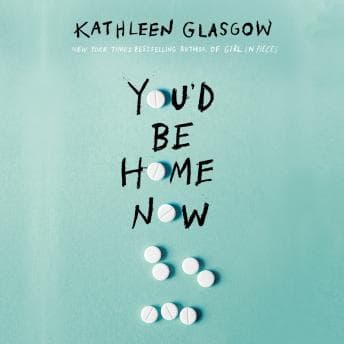

What do you do when your favorite genre is epic fantasy with hard magic systems and someone hands you a YA contemporary about the opioid crisis in small-town America?
Apparently, you sit in your apartment at 2 AM with your headphones on, board games untouched on the shelf behind you, and you don't move for three hours straight. That's what happened to me.
The Quiet Campaign Against Being Known
Look, I'm the guy who measures books by how intricate their world-building is. I want maps and appendices and magic systems with clearly defined rules. You'd Be Home Now has none of that. What it has instead is Mill Haven — a dying mill town in the grip of an opioid epidemic — and Kathleen Glasgow builds it with the same care Sanderson puts into Roshar, just with trailer parks and shuttered pharmacies instead of highstorms. The town itself functions almost like a character. Everyone in Mill Haven has a role assigned to them: the rich family, the burnout, the ghost addicts who haunt the edges of respectability. Emmy Ward's role is "the good one," and Glasgow slowly, painfully peels that label away layer by layer until you're staring at a girl who doesn't know who she is without the identity other people gave her.
This isn't a fantasy quest. But it's a progression story in its own way. Emmy starts at level zero — no agency, no voice, defined entirely by her last name and her brother's addiction — and by the end she's made choices that are genuinely hers. Honestly, the only thing I've read recently that pulled me in with that same zero-to-competence arc was Firebolt, and that one literally has XP. The progression is satisfying, even without stat blocks. (I know. I'm as surprised as you are.)
Joey Ward Is Not a Quest NPC
Here's where Glasgow does something I really respect. Joey — Emmy's brother, fresh out of rehab — could so easily be a plot device. The addict-as-obstacle. The cautionary tale who exists to teach the protagonist a lesson. But Glasgow writes him as a full person who's terrified and trying and failing and trying again, and the book never lets you reduce him to his worst moment. There's a stretch in the middle where Emmy discovers these "ghostie" addicts — people the town has basically erased — and starts seeing her brother's struggle reflected in an entire community that Mill Haven would rather pretend doesn't exist.
I kept thinking about my D&D group back home. We grew up in a rural Georgia county where this stuff wasn't abstract. You knew the houses. You knew the families. Glasgow captures that specific small-town thing where everyone knows everyone's business but nobody actually talks about anything real. The silence is louder than the gossip. Glasgow's gift for environmental awareness — reading a town the way you'd read a battlefield — reminds me of the situational radar drilled into Left of Bang, just applied to emotional survival instead of combat.
Julia Knippen Gets the Teenage Brain Right
So here's where I have to compare, because that's my instinct. I've listened to a lot of YA narration that treats teenage characters like they're either too precious or too dramatic — the performance either over-sells every emotion or flattens everything into monotone "cool." Julia Knippen does neither. She nails this very specific thing about being sixteen or seventeen where you're feeling everything at maximum volume inside your head but what comes out is this careful, guarded flatness. Emmy's internal monologue has real texture — the way she processes her mom's controlling behavior versus her brother's unpredictability versus her own quiet rage at being invisible. Knippen keeps all those threads distinct without turning any of them into melodrama.
Compared to Glasgow's other audiobooks — Girl in Pieces especially — this one feels slightly more restrained in performance, which actually works. The story earns its emotional hits through accumulation, not through big dramatic peaks. It's a slow burn. You're 8 hours in and suddenly you realize you're devastated and you can't quite point to the single moment that did it.
I will say: if you're coming from Girl in Pieces expecting the same raw intensity from page one, this is a different beast. It's wider in scope — less about one girl's immediate crisis and more about how addiction radiates outward through a family, a school, a whole town. The emotional payoff is different but no less real.
Who Should Roll Initiative on This One
If you need dragons or spaceship battles to hold your attention, this isn't your book. (But you're wrong to skip it.) If you've ever lived in a small town where everybody's assigned a story and you're expected to stick to it — yeah, this one's going to hit. It's 12 hours, which is a real commitment for contemporary YA, but Glasgow uses that space. Nothing feels padded.
Content-wise: addiction, family trauma, the aftermath of a fatal car accident. It doesn't shy away from the ugly parts. This is focused-listening territory — don't put it on while you're grinding through a dungeon in Baldur's Gate. Give it your attention.
I read this instead of writing my thesis. Dr. Patel would not approve. But I think my mom — who keeps asking when I'll "do something useful" — would actually understand this one.