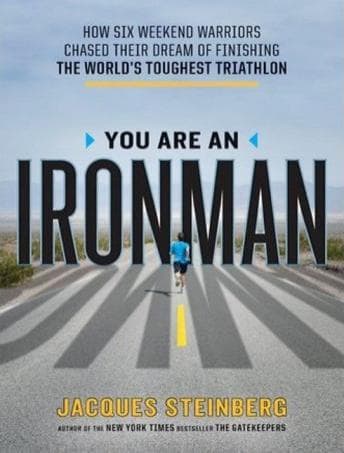

I am the last person who should be reviewing a book about Ironman triathlons. My idea of physical endurance is standing for six straight periods at Fiske High School and then walking the lakefront with Denise on a Saturday morning. That's it. That's my athletic resume.
But Denise and I were doing exactly that last weekend - one of those gray Chicago November mornings where the lake looks like hammered pewter and you just need something in your ears to justify being outside - and somewhere around mile three of this book, I realized I'd completely forgotten about the cold. That doesn't happen often.
This reminds me of what Hemingway said about courage - that it's grace under pressure. Steinberg's book is essentially a 12-hour meditation on that idea, except his subjects aren't bullfighters or soldiers. They're a dentist from Phoenix. A woman juggling kids and a career. Weekend people. Regular humans who decided, for reasons the book spends considerable time trying to understand, that 2.4 miles of open-water swimming followed by 112 miles on a bike followed by a full marathon was a reasonable hobby.
What Steinberg Is Actually Doing Here
Let's talk about what the author is really saying, because this isn't a sports book. Not really. Steinberg - a New York Times education reporter, which tells you something about his instincts - is doing the same thing he did in The Gatekeepers, his book about college admissions. He's using a high-stakes process to examine how ordinary people construct meaning. The Ironman race is his lens. Katherine Boo does something remarkably similar in Behind the Beautiful Forevers - using one Mumbai slum as a lens to examine something much larger about human dignity and the stories we tell ourselves to keep going. What he's actually examining is why adults, with full lives and reasonable excuses, choose suffering voluntarily.
He follows a handful of first-time competitors through the Ford Ironman Arizona 2009, and the structural choice matters: we're not watching professionals. We're watching people who trained at 5 AM before their kids woke up, who bonked on training rides and cried in parking lots and questioned everything. The book earns its emotional moments because Steinberg does the journalistic work - he's in the pool with these people, on the bike routes, waiting at mile markers. You feel the specificity of the Arizona heat, the particular dread of the swim start when 2,000 people enter the water simultaneously. That scene alone - the chaos of bodies, the disorientation, one competitor's description of it feeling like being in a washing machine - is worth the price of admission.
My students would hate this. I love it. There's no irony here, no postmodern distance. It's a book that believes finishing something hard matters. That's almost radical right now.
Kirby Heyborne and the Problem of Sincerity
Heyborne doesn't do voices. No character differentiation, no accents, no performance tricks. For a book like this, that's exactly right. The narrator understands that pause is punctuation - and for a story where the emotional weight is in the waiting, the grinding, the silent miles, a theatrical narrator would've been disastrous.
What Heyborne brings is steadiness. His voice has a quality I can only describe as believing what it's saying. When he reads a competitor's internal monologue at mile 20 of the marathon - that specific kind of bargaining that happens when your body is done but the clock isn't - it doesn't sound performed. It sounds reported. The 12-hour runtime feels earned rather than padded, which is not something I say lightly. I was grading papers at 11 PM for the final three hours and kept putting the red pen down.
The research I have on him doesn't surface any particular weaknesses, and honestly, that tracks. This is clean, committed narration. Nothing flashy. Nothing to complain about. For a book this earnest, that's a feature.
Who Crosses This Finish Line With You
If you're a triathlete or endurance athlete, obviously. But also: if you've ever finished anything hard and needed someone to explain why you did it. If you loved Born to Run but wanted more psychological interiority and less mythology. If you're a biography reader who enjoys watching real people navigate real stakes.
Skip it if you need plot momentum - this is a slow build across a long training season, and the race itself doesn't arrive until late. It's not a thriller. It's more like sitting with someone while they figure something out.
The prose deserves to be savored. Worth pausing the faculty meeting for - and I say that as someone who has paused many faculty meetings for many audiobooks. This one actually deserved it.