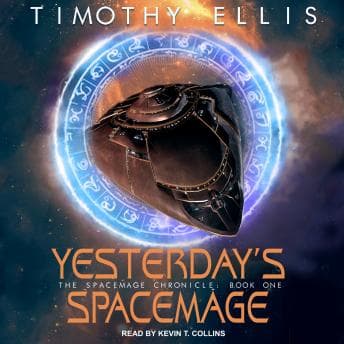

So I'm sitting in my apartment at 1 AM, supposed to be debugging my procedural terrain generation code, and instead I'm three hours deep into a book about a fantasy mage who gets yeeted into a space opera. Look, I'm not proud of my life choices, but I am consistent.
Yesterday's Spacemage scratches a very specific itch - the "what if my D&D character woke up in Traveller" itch that I didn't know I had until Timothy Ellis handed it to me. Thorn is a Battle Mage candidate on Choosing day (capital C, you know how fantasy do), and instead of getting slotted into the expected sword-and-sorcery career track, he gets dumped into a universe of FTL drives and energy weapons. It's portal fantasy, but the portal goes sideways through genre instead of geography. The DNA here is closer to Hitchhiker's Guide to the Galaxy, The Secondary Phase Special than it is to classic epic fantasy - genre-bending as the whole point, not just a quirky backdrop. And honestly? The progression is satisfying. Watching Thorn figure out that his magical toolkit still works - just in completely different contexts - scratches the same brain center as watching a character level up in a LitRPG.
When Your Wizard Rolls a Nat 20 in a Sci-Fi Campaign
The core hook here is strong. Mage-out-of-time adapting combat magic to spaceship warfare is genuinely fun, and Ellis doesn't waste much runway getting there. At 7 hours 20 minutes, this is a lean book by my standards (I'm the guy who considers anything under 20 hours a novella), and it moves. Thorn encounters pirates, slavers, and the general lawlessness of frontier space, and he handles it the way any self-respecting mage would - with raw power applied creatively. If you've ever theory-crafted how a D&D wizard would break a sci-fi setting, this is your book.
But here's where I have to be honest: the world-building is more functional than deep. This is not Sanderson-level world-building. The magic system doesn't get the kind of rigorous rules-lawyering I crave. Thorn has magic, it does stuff, the stuff scales up when the plot needs it to. The sci-fi setting feels more like a backdrop than a lived-in universe - ships exist, blasters exist, space stations exist, but I never got the sense of a fully realized political or economic structure holding it all together. For a 7-hour book that's clearly the first in a series (Spacemage Chronicle), I can forgive some of that as setup. But I wanted more.
The ending is where things get wobbly. Without spoiling it, Thorn makes a choice in the final act that feels... off. Like the character I'd been listening to for six hours wouldn't actually do that thing. Multiple listeners have flagged this, and yeah, I felt it too. It's not book-ruining, but it left a sour note. There's also a political aside - an anti-gun rant that comes out of nowhere and reads less like organic world-building and more like the author stepping in front of the camera. It's brief, but it's jarring enough that people noticed. In a genre where we're suspending disbelief about magic and FTL travel, breaking immersion for a real-world hot take is... a choice.
Kevin T. Collins Carries More Weight Than He Should
Kevin T. Collins is the real reason to go audio here. The guy is an Earphones Award winner for a reason. His narration elevates material that, on the page, might read as fairly standard portal-fantasy-in-space. I don't have specific accent details to call out - he's not doing a Steven Pacey-level vocal circus with wildly distinct character voices - but his pacing and energy keep the book moving. He knows when to punch up the action sequences and when to let quieter moments breathe. For a book this short, that kind of steady hand matters. He's doing the heavy lifting to make you care about Thorn's fish-out-of-water moments, and it works.
I'd compare the experience to listening to a solid B-tier LitRPG: the narrator commitment exceeds the source material's complexity, and that's actually fine. Sometimes you want a popcorn listen.
Who's Rolling Initiative on This One
If you're a LitRPG or progression fantasy fan who's curious about the mage-in-space subgenre, this is a good entry point. Short commitment, fun premise, good narrator. My D&D group would love this as a concept for a one-shot campaign.
If you need hard magic systems with clearly defined rules, or deep sci-fi world-building with economic and political texture, this will leave you hungry. And if ham-fisted political commentary pulls you out of fiction, be warned - there's a moment that might test you.
I read this instead of writing my thesis. Was it worth the setback to my academic career? Eh. It was fun. That's not nothing. But I'm not burning a credit on book two until someone tells me the world-building deepens. Collins' narration almost tips me over, though. Almost.