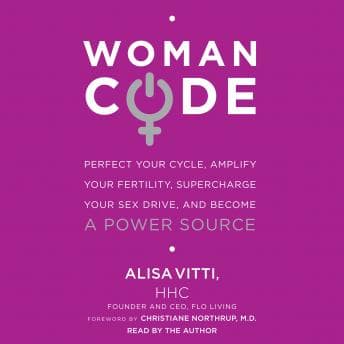

So I'm lying awake at 1AM after a particularly brutal on-call rotation — Kevin's asleep, I've already stress-eaten my way through half a bag of trail mix — and I decide to start WomanCode because honestly, my cycle has been a disaster since I started this job and I figured a health book might bore me to sleep. Reader, it did not.
Alisa Vitti opens with her own PCOS diagnosis story, and it's the kind of personal data point that makes you actually trust the source. She was in her early twenties, gaining weight, losing hair, dealing with acne and absent periods, and her doctors basically shrugged. She reverse-engineered her own protocol through functional nutrition, got her cycle back, and built FLO Living around the methodology. Whether you buy into the full framework or not, the origin story is specific and credible in a way that a lot of wellness authors can't match.
Your Endocrine System is Basically a Distributed System
Okay, hear me out. The central thesis of WomanCode is that your hormones operate as an interconnected system — mess with one node and the whole thing cascades. Vitti breaks this down into what she calls the four major endocrine players: adrenals, thyroid, ovaries, and metabolism. If you've ever debugged a microservices architecture where one failing service takes down three others, this will click immediately. She's essentially arguing that most women are treating symptoms (acne, fatigue, PMS, irregular periods) in isolation when the root cause is upstream — usually blood sugar dysregulation and adrenal burnout.
The five-step protocol she lays out is food-centric: stabilize blood sugar, nurture adrenals, support organs of elimination, sync your diet to your cycle phase, and then engage with the "feminine energy" stuff (this last part is where she lost me a bit, but I'll get there). The discipline-as-system framing actually reminded me of No Excuses!, which takes a similarly modular approach to behavioral change — though Vitti's version is at least grounded in physiology rather than sheer willpower rhetoric. The cycle-syncing concept — eating different foods during your follicular, ovulatory, luteal, and menstrual phases — is genuinely interesting and something I hadn't encountered before. She gets pretty granular: leafy greens and fermented foods during one phase, heavier root vegetables and warming foods during another.
Where the Signal Gets Noisy
Here's my issue. There are stretches — particularly in the middle third — where the book reads like it could've been a really solid blog post series instead of a nearly 8-hour audiobook. Vitti repeats her core concepts frequently, and some chapters feel like she's re-explaining the hormonal cascade for the third time with slightly different framing. At 1.75x, I trimmed this down to about 4.5 hours and honestly, that felt right.
The other thing: Vitti narrates this herself, and she's... fine? Her tone is warm and clear, she obviously knows the material cold, and there's a genuine passion that comes through. But she has a cadence that's very "wellness seminar keynote" — measured, emphatic pauses, that specific inspirational inflection. It's not bad, but after a few hours it starts to feel like a really long TED talk. No vocal variety for the anecdotal patient stories she shares — they all kind of blend together. A professional narrator might have given those case studies more texture. For a self-narrated health book though, she's above average.
I also want to flag: the science is presented accessibly but she doesn't always cite specific studies in a way you can follow up on. She references research broadly — "studies show" — without always naming them. As someone who likes to verify claims, this bugged me. The protocol itself is mostly common-sense nutrition (eat whole foods, cut processed sugar, manage stress), which is hard to argue with, but some of the more specific claims about cycle-syncing foods could use stronger backing.
Who Should Plug In (And Who Should Skip)
Perfect for: anyone dealing with PCOS, irregular periods, hormonal acne, or general "my body is doing weird stuff and my doctor just offered me the pill." If you've never thought about your cycle as having distinct phases that affect energy, mood, and nutrition needs, this is a genuinely useful framework even if you don't adopt the full protocol.
Skip for: anyone who wants rigorous citations, anyone who's already deep into functional medicine literature (you probably know most of this), or anyone looking for a quick tactical listen. This needed an editor with a machete.
Perfect for: focus listening, maybe a long flight. Skip for: the 6AM zombie train. Too much specific dietary info to absorb while half-conscious.
The ROI Calculation
The ROI on this audiobook is decent but not great — there's probably 4 hours of genuinely useful content packed into nearly 8 hours. I've already started tracking my cycle phases against my energy levels (turns out my worst on-call weeks correlate with my luteal phase, which... explains a lot). Kevin asked why I was suddenly eating sweet potatoes at every meal and I told him I was optimizing my infrastructure. He didn't ask follow-up questions.
Could parts of this have been a blog post? Yes. Did I still get actionable value? Also yes. Speed it up and you'll get through it in a few commutes with some real takeaways about how your body actually works.