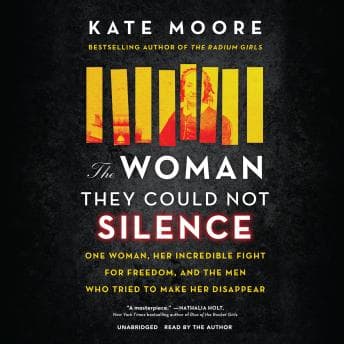

Elizabeth Packard's husband had her committed to an insane asylum because she disagreed with him at Bible study. In 1860 Illinois, that was legal. A husband could institutionalize his wife without her consent, without a medical examination, without due process. Just sign a form and done.
I was up past midnight finishing a turnaround plan for a client - one of those "the company is hemorrhaging and nobody wants to say it" situations - and I put this on thinking it'd be decent background listening. It was not background listening. I stopped working by hour two.
The Original Hostile Takeover
Here's what got me: Elizabeth Packard's story reads like the worst corporate power play I've ever seen, except the stakes are someone's entire life. Theophilus Packard couldn't win the argument, so he eliminated the person making it. Dr. Andrew McFarland, the asylum superintendent, wasn't just complicit - he was a predator who weaponized institutional authority against the women in his care. Moore lays out the systematic machinery of silencing - the legal frameworks, the medical establishment, the social norms - and it's infuriating in a way that business books about "disruption" never manage to be.
What hit hardest: the women on Elizabeth's ward weren't sick. They were inconvenient. Their husbands, fathers, brothers used the asylum system the way bad managers use HR complaints - as a tool to remove people who challenge authority. I've seen this dynamic in boardrooms. Obviously not at the same scale of human destruction, but the playbook is identical: label the dissenter as unstable, question their judgment, isolate them, let the institution do the rest.
This is what my parents did instinctively - kept their heads down, didn't challenge, survived. Elizabeth Packard chose the other path. Both are rational responses to a system designed to crush you.
14 Hours, a British Accent, and a Woman From Illinois
Here's where it gets complicated. Kate Moore narrates her own book, and she's British. Properly British. For a story about 1860s Illinois, American courtrooms, American legal battles - it creates friction. Her pronunciation of "Packard" lands with the stress on the second syllable, almost like "pa-KAHD," and every single time my brain did a tiny recalibration. Over fourteen and a half hours, those tiny recalibrations add up to genuine distraction.
But - and this matters - Moore wrote this book, and you can hear her ownership of every sentence. There's real anger in her delivery when she describes McFarland's manipulations. A quiet fury when she reads the legal language that stripped married women of all autonomy. She knows this material cold, and that intimacy carries the narration even when the accent fights the setting. Not a perfect audio experience. But an honest one.
At 2.0x, this clocked around seven hours for me. Could it have been tighter? Absolutely. There are stretches in the middle where Moore's thoroughness - every legal filing, every letter, every committee hearing - pumps the brakes on momentum. But unlike most padded nonfiction, the details here actually matter. Elizabeth's victory came through paperwork and persistence, not dramatic courtroom theatrics. The boring parts were the weapon. That's a sentence I never expected to type.
Elizabeth Packard Was a Better Operator Than Most Founders I Advise
What separates this from your standard "forgotten woman of history" book is that Moore treats Elizabeth as a strategist, not just a victim. Heroines of History is the genre equivalent of a performance review that says 'meets expectations' - not wrong, not inspiring, moves to the next agenda item. Packard didn't merely survive the asylum - she documented everything inside it, built alliances with other patients, and then systematically dismantled the legal framework that put her there. She got laws changed across multiple states. She self-published books using money she barely had. She turned her worst experience into a platform that freed thousands of women from similar institutional abuse.
That's not inspiration porn. That's execution.
Jenny would say I'm being harsh when I compare this to a startup pivot. Jenny is right. But the principle holds: Elizabeth Packard identified a broken system, found the leverage point, and applied sustained pressure until it cracked. Every founder I work with should be half as strategic.
Buy, Hold, or Skip
If you care about women's rights history, mental health advocacy, or you just want to be properly furious at the legal system for seven-ish hours at double speed - worth the credit. If a British accent narrating American history is a dealbreaker for you, grab the print version instead. If you want something quick, this isn't it. But the length is mostly earned.
Bottom line: this is a 14-hour argument that some fights are worth having even when every institution is designed to make you lose. My parents would've understood Elizabeth Packard perfectly. They just would've chosen differently. And I'm still not sure who was right.