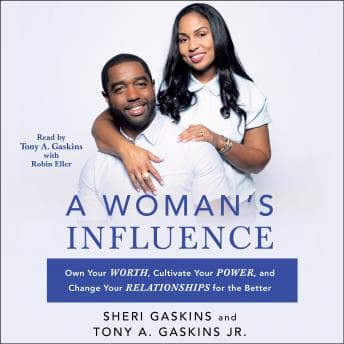

Kevin sent me this as a "joke gift" (his words - I have the text receipts) after I spent an entire Saturday optimizing our shared grocery spreadsheet instead of, you know, talking to him about feelings. So I queued it up during Sunday meal prep, fully expecting to hate-listen. And look... I didn't hate it. But I didn't love it either.
Pair Programming for Relationships (Sometimes)
The thing that actually works here is the Tony-and-Sheri dynamic. The book is structured around 18 "truths" about a woman's influence, and the two of them trade perspectives throughout - Tony with the "here's what men are actually thinking when they pull that garbage" angle, Sheri with the "here's what I did when Tony was still figuring his life out" counterpoint. It's basically pair programming for your love life. Two people debugging the same codebase from different terminals. When they're honest about their own relationship failures - the fights, the immaturity, the moments where Tony admits he was operating in what the book calls "grown boy syndrome" - it feels real. Not polished-podcast real. Actually real.
Tony narrates solo and he's got this warm, pastor-adjacent delivery. Not a professional narrator voice, but that kind of works here? You can hear when he's pulling from actual memory versus reading talking points. The emotional moments land because he's literally the guy who lived it. But he's also not Ray Porter. (Nobody is. That's just science.)
The 72-Hour Rule Is Basically a DoS Attack on Your Own Relationship
Some of the practical advice is solid. "You are not a maid" is a whole chapter that amounts to "stop enabling grown men who treat you like a cleaning service," and sure, obvious - but it's delivered with enough of Sheri's personal stories to feel like more than a bumper sticker. "Show don't tell" works too. Model the behavior, set the standard, let actions do the arguing.
But then there's the 72-hour rule. The idea is that when things go sideways, you make yourself completely unreachable to your partner for three full days. No calls, no texts, nothing. The book frames this as creating space for reflection and showing your partner what life without you looks like.
As someone who debugs distributed systems for a living, deliberately severing all communication channels for 72 hours isn't a repair strategy - it's a denial-of-service attack on your own relationship infrastructure. And the book doesn't really differentiate between "he forgot to respond to your text" and "there's a systemic pattern of disrespect happening here." Those are wildly different failure modes that need different escalation paths. You wouldn't apply the same runbook to a timeout error and a full system outage.
This is my core frustration with the book. Some truths are genuinely useful. Others feel like they exist to hit that magic "18" number for the subtitle. The 7-hour-20-minute runtime is probably 3.5 hours of actual content stretched with repetition and rephrasings. I bumped to 1.75x around hour 2 and didn't miss a single beat.
Who Needs This in Their Queue
If you're in a relationship where you feel like you're shouldering all the emotional labor and need someone to both validate that feeling AND hand you a framework for pushing back - this will hit different. The listener reviews about crying make total sense in that context. Tony's delivery is calibrated for exactly that moment of frustration and exhaustion.
But if you already have a couples therapist (which - everyone should, it's just preventive maintenance for humans), a lot of this covers ground you've walked. And if your brain works like mine - in systems, in root causes, in "but where's the data" - some of the advice reads like patching symptoms instead of fixing the underlying architecture. That same symptom-level focus is what I found in Science the Mind, which also left me wanting deeper root cause analysis.
The ROI on this audiobook is situational. It's a pep talk with structure. A good one, sometimes. But not a systems overhaul. For a real rearchitecture, Atomic Habits drills down to the habit layer in a way that actually stuck with me.
Kevin asked me what I thought. I said "3-star book with 4-star energy." He said that's the most me thing I've ever said. He's not wrong.