
Look, I'll be honest—when I saw "bread wizard" in the premise, I expected something cute and forgettable. The kind of book I'd half-listen to while debugging a particularly annoying race condition. But T. Kingfisher pulled a fast one on me. This is basically Imposter Syndrome: The Fantasy Novel, and I was not emotionally prepared for that at 6:47 AM on a Tuesday.
Mona is fourteen, her magic only works on bread, and suddenly she's the only wizard left to defend an entire city. If that doesn't sound like your first week at a new job where the senior engineer quit and nobody documented anything—congratulations, you've never worked in tech.
Bob the Gingerbread Cookie Deserves His Own Spin-off
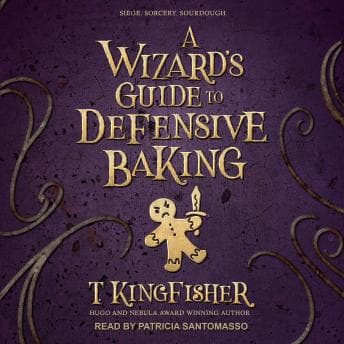
The real star here isn't Mona. It's Bob. Bob is a gingerbread man who can't be killed (Mona tried, he just keeps coming back), has the personality of a caffeinated chaos gremlin, and communicates entirely through aggressive gestures. He's like if someone gave a sourdough starter a tiny sword and an attitude problem.
Kingfisher's humor lands consistently—dry, self-aware, never trying too hard. Mona's internal monologue has this anxious practicality that felt uncomfortably familiar. She's not a Chosen One. She's just a kid who's good at making bread rise and suddenly has to weaponize that skill against an assassin. The scene where she figures out how to use bread dough defensively? Genuinely clever. The Shape of Water pulls off that same trick—taking something mundane and making it feel genuinely magical without asking you to suspend all disbelief. Not "fantasy clever" where you just accept the author's rules. Actually clever.
Patricia Santomasso: The Narrator Debate
Okay, so here's where opinions get spicy. Santomasso's performance is... divisive. Some folks think she nails Mona's youthfulness without making her sound like a cartoon kid. Others (and I get this) felt she sounded too proper, too composed for a panicking fourteen-year-old.
My take? She's solid. Good comedic timing—which matters a lot here because Kingfisher's humor is all about delivery. The breathy quality works for Mona's anxiety, though I can see how it might read as "fretful adult" rather than "terrified teenager" to some ears. She doesn't do wild vocal gymnastics for different characters, but you can always tell who's speaking.
At 1.5x (my default), the pacing felt right. The book's only 8.5 hours, which is perfect—no bloat, no padding. I finished it in exactly four commutes, and that included the morning where BART was delayed for 20 minutes because of "police activity" and I just sat there with my coffee getting increasingly invested in bread-based warfare.
When Cozy Gets Dark (And It Does)
Fair warning: this isn't entirely a comfort read. There's a dead body in chapter one. The assassin plot has real stakes. Mona deals with trauma in ways that feel authentic—not "YA protagonist shakes it off" authentic, but actual processing of scary things happening to her. Kingfisher doesn't shy away from the fact that adults are failing this kid, and the political subplot about how the city treats its wizards has some bite to it. That darker undercurrent reminded me of The Wood Beyond the World, which also refuses to let its fantasy setting be purely escapist.
The pacing in the back half picks up significantly—some reviewers thought there were too many battles, but honestly? After the slower buildup, I appreciated the payoff. Though if you're listening while trying to do actual work, maybe pause during the climax. I almost sent a Slack message that just said "BOB NO" to my entire team.
Best Listening Conditions
This is a fantastic multitasking audiobook. The plot is straightforward enough to follow when you're half-asleep, but the writing is sharp enough to reward attention when you can give it. Great for commutes, cleaning, light debugging. I'd skip it for deep work sessions—you'll want to actually listen, not just have it on.
Who should skip it: If you need your fantasy protagonists to be Powerful and Competent from page one, this will frustrate you. Mona spends a lot of time scared and in over her head. That's the point, but it's not for everyone.
Who will love it: Anyone who's ever been the most junior person in the room when everything went sideways. Anyone who appreciates humor that doesn't undercut emotional stakes. Anyone who wants a fantasy book that respects its young protagonist without making her a prodigy.
Worth the Credit?
Eight and a half hours for a complete, satisfying story with a genuinely original magic system, a protagonist who earns her victories, and a gingerbread cookie I would die for. Santomasso's narration is competent if not transcendent. No audio issues, clean production, easy 1.5x listening.
Is it Ray Porter? No. But it's a really good time, and sometimes that's exactly what you need between production incidents.