
I started Dead Med on a late-night drive home from a friend's place, and honestly, the timing couldn't have been more fitting. There's something about Freida McFadden's medical thrillers that pairs disturbingly well with empty highways and the kind of darkness where your headlights feel like the only light left in the world.
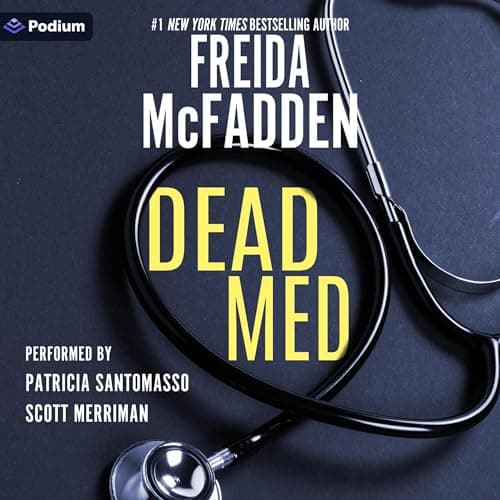
Dead Med — originally published as Suicide Med and now revised with about 20% new material — drops you into a medical school with a grim reputation. Students have been overdosing, and the school has earned its nickname the hard way. At the center of it all is Heather McKinley, a first-year med student whose life is unraveling in that uniquely awful way where everything collapses at once: her boyfriend leaves, her anatomy grade tanks, and the pressure of med school starts pressing down like a vice. Then, on the night before the anatomy final, a gunshot echoes through the building. And then things get worse.
The structure here is what sets Dead Med apart from McFadden's more recent page-turners. Multiple POVs layer the same events from different angles, gradually peeling back what actually happened that night. If you've read her bigger hits like Never Lie or The Housemaid, you'll notice this one feels different — rawer, maybe a little less polished in its plotting, which makes sense given its origins as an earlier work. The layered perspectives are genuinely clever, and when the pieces click into place, there's a satisfying sense of revelation. But the road to get there can feel long.
Patricia Santomasso and Scott Merriman handle the dual narration well. Santomasso captures Heather's escalating anxiety with a restrained intensity that keeps the tension simmering without tipping into melodrama. Merriman brings a different energy to his chapters, and the contrast between their voices makes the perspective shifts easy to track. There's no full-cast pyrotechnics here — just two solid narrators doing clean, focused work. The production is straightforward: no music, no sound effects, just voices and story. It works for the material, though I wouldn't say the narration elevates the book the way some McFadden audiobooks manage to.
Here's where I have to be honest about the experience: the first half tested my patience. The time spent establishing the various POV characters and their individual struggles is necessary for the payoff, but it can feel like setup without enough forward momentum. I found myself checking the progress bar more than once during the early chapters, wondering when the night of the shooting would finally arrive. When it does, the book kicks into a higher gear, and the short chapters start flying by. But if you're coming to this expecting the relentless pacing of McFadden's more recent work, you might feel the drag.
The ending is where Dead Med either wins you over or leaves you cold, and this seems to be the biggest point of contention among listeners. Some found the resolution anticlimactic — all that buildup leading to a twist that didn't land with the force they expected. Others, myself included, thought the epilogue was the strongest part of the book. It leaves a slightly haunting impression, the kind of ending that sits with you after the credits roll. The ambiguity is deliberate, and whether that's satisfying depends entirely on what you want from your thrillers.
The med school setting gives the book a texture you don't get in most psychological thrillers. McFadden is a practicing physician, and that expertise shows in the details — the anatomy lab scenes, the exhaustion, the particular flavor of desperation that comes from a career path that demands everything and punishes weakness. It's not glamorized. It feels lived-in and a little suffocating, which is exactly right for this story.
At ten hours, Dead Med is a reasonable commitment, though I'd argue it could have been tighter at eight. The multiple perspectives occasionally retread ground you've already covered, and while each retelling adds new information, the pacing suffers from the repetition. I ran into the same wall with What Alice Forgot, where the slow unspooling of information felt deliberate but cost the book some momentum in the middle stretch. Bumping the speed to 1.25x during the early chapters helped me stay engaged without losing anything.
If you're a McFadden completist or you're drawn to medical settings with real psychological weight, this is worth your time. If you need breakneck pacing from the jump or clean-cut endings that tie everything up, you'll probably get restless before the payoff arrives. This isn't McFadden's sharpest work, but it's an interesting one — darker and more structurally ambitious than some of her bigger sellers, even if the execution doesn't always match the ambition. The dual narration is clean, the setting is distinctive, and the final act delivers enough to justify the slower burn. Just know that Dead Med earns its name slowly, and the payoff is quieter than you might expect.