
Bottom line: This is one of the most important audiobooks I've listened to this year, and it's not even close to being a business book.
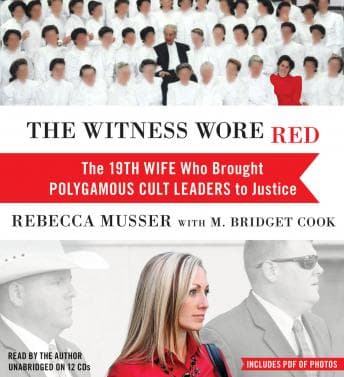
Look, I don't usually venture outside my lane. My Audible library is 90% business strategy and leadership memoirs. But Jenny's been on a true crime kick since that Netflix documentary dropped, and she basically said "David, you need to understand why I've been crying on the couch for three nights." So I downloaded The Witness Wore Red expecting to check a box. Instead, I got a crash course in organizational dysfunction, cult psychology, and what happens when systems designed to protect people become systems designed to exploit them.
The Slow Build That Pays Off
Here's the thing about this audiobook - the first few hours are rough. Not rough in content (though that too), but rough in pacing. Rebecca Musser's voice is soft. Almost too soft. I cranked it to 2.0x like I do with everything, and even then I had to really focus. She reads like someone who's still processing trauma while recounting it, which - yeah, that's exactly what's happening.
But somewhere around the escape section, something shifts. The narrative tightens. Her voice gets stronger. And suddenly I'm sitting in my car in the parking garage at a client site, fifteen minutes late to a meeting, because I cannot stop listening to this woman describe what it took to leave everything she'd ever known.
My parents left Korea with nothing. Built a life from scratch in a country that didn't want them. I've always thought that was the hardest thing a person could do. Rebecca Musser left a closed society where she'd been married off to an 85-year-old man at 19 and then had to come back - voluntarily - to testify against the people who raised her. That's a different kind of courage entirely.
When the Author IS the Narrator
I'm usually skeptical of author-narrated audiobooks. Most business authors should stick to writing. Their delivery is flat, they rush through the good parts, they don't know how to use silence. Rebecca Musser has none of those problems. Yes, she's not a professional narrator. Yes, there's this occasional Texas accent thing that pops up and feels a little forced. But honestly? I stopped noticing.
Because here's what you can't fake: authenticity. When she describes the "placement" system - where Warren Jeffs would assign women to men like property - you can hear the disgust in her voice. When she talks about her little sisters, still trapped, you hear the guilt. When she recounts her courtroom testimony, there's this quiet steel that comes through.
No professional narrator could have delivered that. This is her story. She earned the right to tell it.
The Business Case for Understanding Cults
(Yes, I'm making this about business. Jenny says I can't help myself. Jenny is right.)
But seriously - if you want to understand how toxic organizational cultures form, how charismatic leaders manipulate systems, how good people get trapped in bad structures - this is required reading. Warren Jeffs didn't build the FLDS overnight. It was decades of small compromises, incremental boundary violations, systematic isolation from outside information.
I've seen this pattern at three different companies. Obviously not to this extreme. But the mechanics? The way dissent gets silenced, the way loyalty becomes more valued than ethics, the way "the way we've always done things" becomes an excuse for abuse? Same playbook. I saw a different kind of systemic thinking in Brief Answers to the Big Questions - Hawking breaking down how we accept certain frameworks without questioning their foundations.
Every founder, every executive, every manager should understand how these dynamics work. Not because they're running cults (hopefully), but because the warning signs are the same. And most people don't recognize them until it's too late.
Who This Is (and Isn't) For
If you watched Keep Sweet on Netflix and want the deeper story - obviously yes. If you're interested in cult psychology, survivor narratives, or true crime that actually matters - yes. If you're a leader who wants to understand how organizations can go catastrophically wrong - surprisingly, also yes.
Skip it if you need fast pacing from minute one. Skip it if detailed accounts of abuse and child marriage will be too much. (The content warnings are real. This is heavy stuff.)
At 14 hours, this isn't a quick listen. But unlike most 14-hour audiobooks, it earns every minute. The detail-heavy early sections build the world you need to understand. The payoff - watching Rebecca take the stand and systematically dismantle the men who abused her and thousands of others - is worth the investment.
Jenny was right to make me listen to this. I'm not going to tell her that directly, but if she reads this review, there it is.