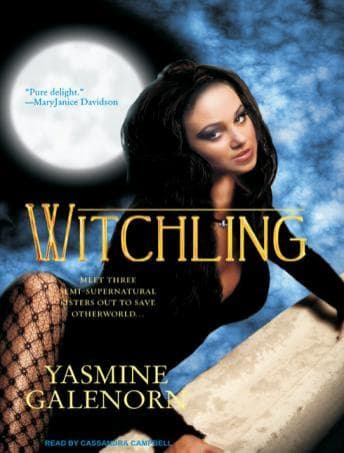

So here's the thing - everyone kept telling me Witchling was this fun, campy urban fantasy romp, and I went in expecting something closer to Dresden Files energy. What I got was... different. Not bad-different, just aggressively 2006 urban fantasy different. And honestly? I kinda had a good time with it, even if my inner world-building snob was twitching the whole way through.
I was deep into a coding sprint at 2 AM - supposedly debugging my procedural dungeon generator for my thesis, actually just avoiding Dr. Patel's latest "let's schedule a check-in" email - when I threw this on. Ten and a half hours felt like a reasonable commitment for a palette cleanser between Stormlight rereads.
Three Half-Fae Sisters Walk Into a Portal Bar
The premise is basically what happens when you build a D&D party entirely out of characters whose players rolled nothing but natural 1s on their ability checks. Camille's a witch whose spells misfire constantly. Delilah turns into a house cat when she's anxious. Menolly is a vampire who's... not great at vampiring yet. They work for an interdimensional intelligence agency called the OIA, and they're supposed to guard a portal at a bar called the Wayfarer Inn.
If you're thinking "that sounds like someone's homebrew campaign notes" - yeah, it kind of does. And I mean that with genuine affection. Galenorn throws species, factions, and realms at you with the enthusiasm of a DM who has binders full of lore and wants you to see ALL of it. That same binder-energy, world-building-first approach is all over Dragonfriend, which throws you into its lore headfirst with similar chaotic enthusiasm. The Otherworld has its own politics, there are Subterranean Realms with a demon lord named Shadow Wing who wants to collect soul-eating seals, and Earth is basically this backwater dimension that nobody takes seriously. My D&D group would love this setup.
But here's where it gets complicated. The world-building is wide rather than deep. Galenorn introduces a LOT - faeries, demons, vampires, weres, dragons, fox spirits - and the book doesn't always have time to make you feel the weight of any of it. Compare that to, say, how Sanderson introduces Allomancy in Mistborn, where you understand the costs and rules before things get wild. Here the magic system is more vibes-based. Camille's powers malfunction because of her mixed blood, but the rules for when and how feel arbitrary. Sometimes it's plot-convenient chaos, sometimes it's just chaos.
The uneven tone that some readers complain about? It's real. Never Dead has a similar tonal whiplash problem, and I think it comes from the same place - authors who are genuinely excited about everything in their world and haven't quite figured out what to subordinate. You'll go from a genuinely creepy murder scene at the Wayfarer to a casual aside about lingerie shopping in the span of a chapter. The book can't quite decide if it wants to be paranormal romance, urban fantasy thriller, or comedic adventure, so it tries to be all three at once.
Cassandra Campbell Does the Heavy Lifting
Campbell is doing solid work here. She gives the three sisters distinct enough voices that you always know who's talking - Camille gets this confident, slightly sardonic delivery, and she shifts gears for Delilah's more anxious energy. The various male characters and supernatural creatures get differentiated too, though none of the voices hit that Steven Pacey level where you forget there's only one person in the booth. (Steven Pacey walked so other narrators could run, and I will die on that hill.)
Here's the split I noticed in how people respond to Campbell on this one: if you vibe with her slightly theatrical style, she carries the campier elements of the writing really well. If you don't, the combo of her delivery plus Galenorn's occasionally over-the-top prose might grate. I landed on the positive side - she keeps the story moving and made those 2 AM hours slip by without me noticing. But I get why it's polarizing. There's a confidence to her read that either sells the material or highlights its rougher edges, depending on your tolerance.
No sound effects, no music, just straight narration. Clean production. Nothing to complain about technically.
Who Should Queue This Up (And Who Should Run)
If you grew up on Buffy, if you've ever played a chaotic neutral character in a campaign just for the laughs, if you like your urban fantasy with a healthy dose of romance and don't need your magic systems to come with a physics textbook - this is a fun listen. It's the book equivalent of a one-shot D&D session where nobody's taking notes but everyone's having fun.
If you need Sanderson-level world-building or tight plotting, this isn't for you. The info-dumps are there but they're the scattershot kind rather than the satisfying kind. And the sexual content is present but not overwhelming - more spice than full heat.
At 10.5 hours, it's not asking for a huge time commitment. I read this instead of writing my thesis, and I don't regret it. But I also probably won't bump book two ahead of my reread queue.
Rolling a Solid 14 on the D20
Witchling is a competent, entertaining opener to a long urban fantasy series. It's not going to change your life, and the magic system isn't chef's kiss - more like chef's shrug. But Galenorn's enthusiasm for her world is infectious, Campbell narrates with energy, and sometimes you just want a fun fantasy romp where three misfiring sisters fight demons. Not every listen needs to be a 40-hour epic. Sometimes a 10-hour dungeon crawl with broken characters is exactly right.