
Look, I'll be honest — Regency romance isn't my usual territory. I'm the guy who spends his evenings with Dostoevsky and argues with teenagers about the green light in Gatsby. But Denise has been pushing this series on me for weeks, and last Saturday she finally just queued it up on my phone before we headed out for our lakefront walk. "Just try it," she said, with the same tone I use when handing a student The Sun Also Rises. And here's the thing: I didn't turn it off.
Not even close.
What Austen Started, Warren Keeps Running With
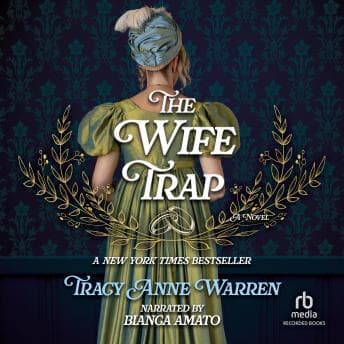
Let's talk about what Tracy Anne Warren is really doing here, because it's smarter than it looks. Wife Trap takes Lady Jeannette Brantford — aristocratic, sharp-tongued, exiled from polite English society — and drops her into rural Ireland where she falls for Darragh O'Brien, a common architect. On the surface, sure, it's the class-crossing romance you've seen before. But Warren understands something about Regency fiction that a lot of writers in the genre miss: the social architecture matters as much as the love story. Jeannette's banishment isn't just a plot device to get her near a handsome Irishman. It's punishment, and she feels it. The way Warren writes her wounded pride — this woman who knows she's been cast out and refuses to let anyone see it crack — reminded me of what Hemingway said about courage being grace under pressure. Jeannette wouldn't appreciate the comparison. She'd probably find Hemingway insufferable. But the principle holds.
This is the second book in the Trap Trilogy, and it works fine as a standalone, though I suspect fans of The Husband Trap will catch callbacks I missed. The Irish setting gives it a different texture from the London drawing rooms you'd expect — Warren uses the countryside and the slower rhythms of provincial life to force Jeannette into situations where her aristocratic armor doesn't work. She can't just out-rank Darragh. She has to actually deal with him as a person. The tension isn't just "will they or won't they" — it's "can she become someone who would?"
My students would hate this. I love it.
Bianca Amato Does Something I Didn't Expect
Here's where I have to eat a small serving of crow. I've listened to hundreds of audiobooks narrated by women performing male characters, and the results range from passable to painful. Bianca Amato doesn't just pass — she genuinely differentiates. Her male voices carry actual weight and distinct personality. One listener put it perfectly: male voice work is a "do or die" for audiobook romance, and Amato survives with room to spare. You always know who's speaking, which sounds like a low bar until you've sat through a twelve-hour romance where every character sounds like the same person with slightly different pitch.
What I appreciated most was her restraint. She doesn't overperform the emotional moments — no weeping into the microphone, no breathless gasping during the romantic scenes. The narrator understands that pause is punctuation. When the story builds toward its final hours — and it does build, slowly, like a good argument — Amato lets the prose do the heavy lifting. I found myself, somewhere around hour ten, sitting at the kitchen table supposedly grading sophomore essays on To Kill a Mockingbird, completely ignoring a stack of papers because I needed to know how Warren was going to land this thing.
Bianca Amato brings that same narrative patience to her work on Taming of the Queen, where she navigates Tudor court intrigue with the same restraint she shows here—letting the power struggles breathe rather than overplaying them.(Denise walked in, saw my face, and just said "Told you." Marriage is humbling.)
Twelve Hours Is a Lot of Countryside
I won't pretend this is flawless. At 12 hours and 32 minutes, the middle section takes its time in a way that occasionally tested my patience. There are stretches where the Irish setting, lovely as it is, starts to feel like Warren is running out the clock before she lets the real conflict ignite. The prose deserves to be savored, but some passages could've been tightened without losing anything essential. If you loved Pride and Prejudice — and I mean the long-game romantic tension of it, not just the witty banter — this is its spiritual successor in terms of pacing. Which means: patience required.
But that ending earns the slow build. The final few hours locked me in completely.
Who Gets Trapped (And Who Escapes)
If you're a Regency romance listener who values character work over action, and you want a narrator who actually differentiates a full cast through voice alone, this is worth your time. If you need fast pacing and can't handle a slow burn, you'll struggle through the middle third. And if you're an English teacher who's been quietly snobbish about genre fiction for two decades — well. Consider yourself warned. Denise has already queued up book three.