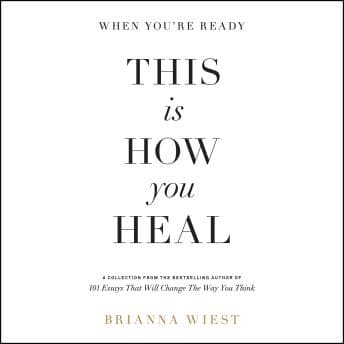

I have a bone to pick with self-help books that promise healing like it's a destination you can GPS your way to. "Turn left at trauma, your emotional wholeness is on the right." So when Brianna Wiest opens with the premise that healing isn't a one-time event but an ongoing process of waking up from unconsciousness—I actually sat up straighter during my morning jog through Cambridge. Finally. Someone who gets it.
The research shows that most people don't heal in linear trajectories. They spiral. They regress. They have breakthrough moments followed by Tuesday afternoon meltdowns over nothing. Wiest seems to understand this at a cellular level, and her 45+ essays read less like prescriptive advice and more like permission slips for the messy work of becoming yourself.
The Psychology Here Actually Tracks
What makes this collection compelling is that Wiest isn't selling quick fixes. She's describing the phenomenon my colleagues and I see in research all the time—the way sudden loss functions as a pattern interrupt, forcing people out of what she calls "adapted personas." That's not just pretty language. That's attachment theory meeting narrative identity theory in a way that's surprisingly rigorous for something marketed as inspirational.
I found myself asking: why does this land differently than the dozens of similar books cluttering up the self-help section? Part of it is structure. These are essays, not chapters building toward a thesis. You can dip in during a rough week, find something that speaks to where you are, and leave the rest. My therapist would have thoughts about this format—probably good ones, honestly. It mirrors how actual therapeutic insight works. Not linear. Not complete. Just... useful in the moment you need it.
Stacey Glemboski as Quiet Companion
Here's where I have to be honest about what the research didn't give me. I can't point to a specific moment where Glemboski's narration made me cry or laugh or stop mid-stride. What I can tell you is that her delivery is clear and soothing in a way that doesn't tip into saccharine. For content this reflective, that's the right call. You don't want someone performing healing at you. You want someone reading alongside you.
Some listeners gave this low ratings for "lack of engagement," and I suspect those are people who wanted more vocal dramatics. But this isn't a thriller. It's not supposed to grab you by the collar. It's supposed to sit with you while you do the grabbing yourself. The narration is encouraging without being pushy—which, if you've ever had a therapist who pushed too hard too fast, you know is a delicate balance.
At six hours and change, it's a reasonable commitment. Not so long that you lose the thread between listening sessions, not so short that it feels like a pamphlet.
Who Should Listen (And Who Should Skip)
If you read Wiest's previous bestseller and found it useful, this is more of that—matured, maybe. Deeper. If you're in the early stages of processing something difficult and you need language for what's happening inside you, this is that language.
But—and this is important—if you're looking for actionable steps, specific exercises, or a structured program, you'll be frustrated. This is a fascinating case study in the difference between insight and intervention. Wiest offers the former generously. The latter you'll have to supply yourself.
If you're skeptical of anything that sounds remotely spiritual or poetic, this probably isn't your book. She uses words like "inner sanctum" and "becoming" without irony. I'm a researcher who deals in empirical evidence, and even I found it useful—but I can see how it would grate on certain listeners.
The Prescription I'd Actually Write
Listen to this in contexts where you have space to think. Not background noise while cooking (though I tried that—doesn't work as well). Not during a workout where you're pushing hard. This is bedtime listening. This is sitting-with-your-coffee-before-the-day-starts listening. It rewards attention without demanding it.
Wiest understands human nature in a way that feels earned rather than theoretical. She's not quoting studies at you. She's describing what it feels like to be inside a healing process, and she's doing it with enough precision that you recognize yourself. This Naked Mind does something similar with addiction—it's less about steps and more about understanding the internal architecture of your own patterns.
Is it going to change your life? That depends entirely on whether you're ready—which, I suppose, is the whole point of the title.