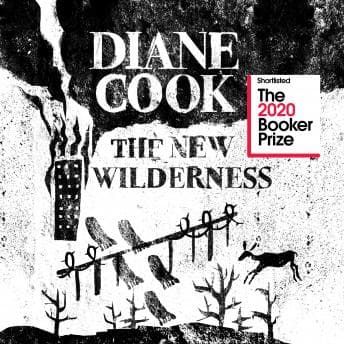

"We are not meant to be here."
That line hit me somewhere around hour two, wedged between a guy manspreading into my left knee and someone's alarm going off for the third time on the 6:47 Caltrain. And I just... sat there. Because Diane Cook's The New Wilderness had already gotten its hooks in me, and that quiet devastation of a line — about humans in a place that doesn't want them — felt uncomfortably apt for a packed commuter train at dawn.
Survival Mode Looks Different Than You Think
TL;DR: This is basically Station Eleven meets Lord of the Flies, but with a mother-daughter relationship as the fault line. And it's way more uncomfortable than either of those.
Here's the setup: Bea drags her sick five-year-old daughter Agnes into the last remaining Wilderness — capital W — because the City is literally killing her. They join a group of twenty volunteers in a government experiment where they have to live nomadically, leave no trace, and basically cosplay as prehistoric humans while bureaucrats with clipboards evaluate whether they're doing it right. The Rangers who oversee them are equal parts park service and authoritarian regime. There's a guy named Carl whose whole job seems to be moving the Community whenever they get comfortable, tracking their ecological impact like a particularly hostile scrum master filing compliance tickets.
What Cook does that I didn't expect: this isn't really a survival thriller. It's a slow, brutal dissection of what happens to human relationships when you strip away every comfort and institution. The Community develops its own power structures, its own cruelties. People pair off, betray each other, rationalize violence. And at the center, Bea watches Agnes — the kid she sacrificed everything to save — become feral. That same grinding social collapse — the way a group turns on itself when the rules dissolve — is exactly what made Red Rising so compulsively listenable for me, though Cook strips away every last shred of the triumphant genre scaffolding that Pierce Brown leaves intact. Not metaphorically feral. The girl starts identifying more with the land than with her own mother. She bonds with the other Community children into this half-wild pack that makes their own rules. There's a scene where Agnes kills her first animal, and the way Cook writes it — no drama, no horror-movie framing, just matter-of-fact — genuinely unsettled me more than most horror I've listened to this year.
The motherhood angle is what elevates this beyond standard dystopia. Bea's whole identity is wrapped up in being the mom who saved her daughter. But Agnes doesn't want to be saved. She wants to belong to the Wilderness. Watching Bea process that — the slow realization that her daughter is thriving precisely because she's becoming someone Bea doesn't recognize — that's the real gut-punch of this book.
Glemboski Carries the Weight
Stacey Glemboski was new to me, and she's not Ray Porter (obviously — need I say more about Ray?), but she handles this material with a restraint that really works. Her Bea is tired and determined, which is exactly right. She doesn't oversell the emotional moments, and for a book this heavy, that's critical. When things get dark — and they get dark, there's a death around hour seven that I'm still thinking about — Glemboski's delivery stays grounded. No vocal histrionics.
The one thing I'll flag: character differentiation isn't her strongest suit. In a Community of twenty people, some voices blur together, and I occasionally lost track of who was speaking in group scenes. Not a dealbreaker, but at 6AM brain capacity, I did rewind a few times during the early chapters when the cast is still getting established.
Pacing-wise, this is a slow burn. Genuinely slow. The middle section — hours five through eight or so — meanders in a way that mirrors the Community's aimless wandering but tested my patience. Cook's writing style is emotionally intense and sometimes heavy-handed; there are passages where she's basically holding your face toward the environmental allegory and going "do you SEE it?" Yeah, Diane. I see it. I commute past the drought signs on 101 every day. I see it.
Who Should Queue This Up (And Who Shouldn't)
Perfect for: train, long walks, anything where you can sit with uncomfortable feelings. This is a book that rewards a bit of emotional space.
Skip for: gym, anything where you need adrenaline. This is not an action book. It's a quiet devastation book.
If you loved Station Eleven's literary-apocalypse vibe or The Road's unflinching parent-child dynamic, this is your next listen. If you bounced off Piranesi for being too slow and atmospheric — this will test you harder. If you need likeable characters, fair warning: Bea makes choices you'll hate, and the Community members range from sympathetic to genuinely awful.
The ROI on this audiobook is high if you're in the right headspace. I finished it across four commutes plus one late-night session after Kevin fell asleep and I couldn't stop thinking about Agnes and those damn Rangers. It's the kind of book that makes you stare out the train window for ten minutes after a chapter ends.
Booker shortlist was deserved. Not flawless — the pacing sags and Cook occasionally trusts her metaphors less than she should — but this one stuck with me. Still debugging my feelings about that ending.
Commute-worthiness: 3.5/5. Followable at 6AM but you'll want to be at least one coffee deep.