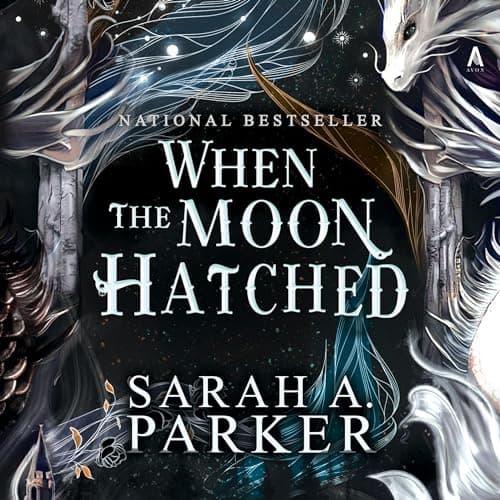

What does grief sound like when the train is screeching hard enough to rattle your fillings? I started When the Moon Hatched on the 1 Line into downtown Seattle, one hearing aid fighting the rail noise, the other feeding me Sarah Mollo-Christensen's first sharp edges as Raeve. Dead dragons becoming moons - then falling out of the sky - is exactly the kind of premise that makes me stop scrolling and actually pay attention.
And this one needs attention. Not casual earbuds-in, folding-laundry, half-listening attention. Real attention.
Dead dragons, prison walls, and a romance built on ache
Sarah A. Parker goes huge here. Not "big world" in the generic fantasy way - big as in the sky itself has dragon tombstones hanging in it, and the whole book keeps reminding you that death in this world is visible. Physical. Looming. That image does a lot of heavy lifting for the atmosphere, and honestly, it worked on me.
The plot thread that grabbed me fastest was Raeve's status shift: assassin for the rebellion group Fíur du Ath, then suddenly imprisoned by the Guild of Nobles and turned into a political symbol instead of a person. That's a strong fantasy-romance engine because it gives the story two kinds of pressure at once - intimate and public. She's not just in danger; she's being used. You can hear the humiliation and the fury rubbing against each other.
Then there's Kaan Vaegor, who has already taken the head of a king and put on a melted crown. That is such a metal little detail, and the audiobook leans into it. He isn't introduced as a clean romantic ideal; he arrives carrying grief, violence, and the kind of authority that sounds heavy even in silence. When the story pulls him toward the capitol's high-security prison and into Raeve's orbit, the emotional stakes finally click. Not because the book gets simpler - it doesn't - but because the ache between them gives all that lore a pulse.
I get why listeners are split on pacing. This is a 20-hour commitment, and Parker does not sprint through her mythology. If you love poetic fantasy that wants you to sit in the hurt, the mystery, and the world logic, that length feels earned often enough. If you need clean-forward momentum every hour, you're going to feel the drag. Some side material and perspective sprawl blur together instead of sharpening the main line. Missed opportunity for tone shift here and there, especially when revelations should land like a blade and instead arrive in the same lyrical register as everything else.
Two voices, one emotional temperature
Sarah Mollo-Christensen and Fajer Al-Kaisi make a smart pair for this material. Mollo-Christensen gives Raeve a clipped, defensive intensity that never turns brittle. She sounds like someone who has survived by reacting half a second faster than everyone around her. But she also leaves room for cracks - and that matters, because Raeve can't just be steel for 20 hours. This narrator actually performs, not just reads.
Al-Kaisi's Kaan lands lower and steadier, with a grief-weighted depth that sells the character's history before the text explains all of it. I especially liked the contrast between Raeve's sharper attack and Kaan's more anchored sorrow. The emotional layers come through even without full sound. That's not me being poetic; that's me talking as a hard-of-hearing listener who depends on clarity, cadence, and emotional contour as much as raw volume.
I also heard why some people call this performance monotone. It's not flat, exactly. It's more that both narrators stay committed to the book's solemn, wounded tone for long stretches, and the result can feel emotionally compressed when the story wants more dynamic lift. If you're waiting for wild tonal pivots, flirtier sparkle, or sharply separated side-character energy, you may find the delivery too controlled. A few of the many perspectives don't pop as distinctly as I wanted, which matters in a lore-dense fantasy where names, factions, and motives are already asking a lot of your working memory.
Clarity over speed - always. On that front, the audio does well. No glaring pronunciation issues jumped out. No gimmicky effects, no distracting production tricks, just clean dual narration. Accessibility done right. And yes, download the supplemental PDF. In a world this layered, any visual anchor helps. For listeners like me who often sync text with audio, that extra material isn't fluff; it's support.
I ended up preferring this around 1.15x. Not because the narrators are bad at standard speed, but because the book's lyrical style plus its length can start to pool if you listen too slowly.
If you want immersion, you have to give it your focus
This is the trade-off: you get a fantasy romance with real mythic scale, a violent grief-soaked love story, and worldbuilding weird enough to stand apart in a crowded market. You give up breeziness. You give up instant clarity. And you definitely give up the idea that this will work as background audio while you answer emails.
For me, the strongest parts were the ones that fused concept and feeling - dragon moons hanging over everything, Raeve being weaponized by the nobility, Kaan dragging his old pain into a prison encounter that clearly means more than either character can safely admit. Those pieces feel specific. Memorable. The performance is layered enough to feel. The grief-soaked emotional weight here reminded me of something I felt reading Great Alone: A Novel — that same sense of a story that earns its devastation by refusing to look away from it.
But I can't ignore the bloat. There were stretches on the subway where I realized I'd been admiring the mood more than tracking the mechanics, and that's a warning sign in audio. If your brain loves assembling fantasy architecture from fragments, great. If not, this may land as "complicated genius or just incoherent," and I honestly understand both reactions.
Who Should Listen (And Who Should Skip)
Listen if you want moon-sized grief, dragon lore, and romance that burns slow under a lot of ash - and you're willing to give it your full focus for 20 hours. Skip if you need your fantasy cleaner, faster, or functional as background listening.
My last stop on this one
As a hard-of-hearing listener this hit different. Not because it was easy - it wasn't - but because the narrators respect the emotion instead of flattening it, and the clean production gives the book room to breathe. I'd spend a credit on this. If you need your fantasy cleaner and faster, borrow it first.