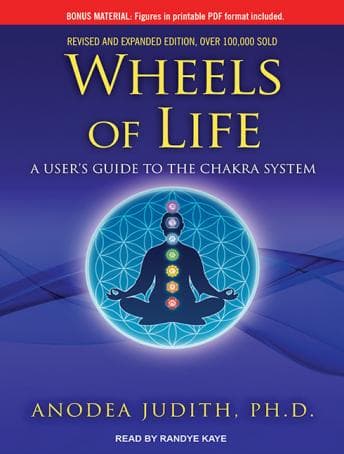

Look, I need to get something off my chest: I am a distributed systems engineer who listens to books about quantum physics for fun, and even I hit a wall trying to follow the chakra-to-quantum-mechanics analogies in this book at 6:15 AM on a packed Caltrain. Anodea Judith is clearly brilliant — psychology PhD, decades of chakra research, the whole package — but she throws around physics metaphors with the confidence of a startup founder explaining blockchain, and sometimes with about the same level of rigor.
Okay. Deep breath. Let me be fair.
The Reference Architecture for Your Energy Body
TL;DR: Worth your commute — but only if you treat it like a textbook, not a casual listen.
This is basically the O'Reilly manual for chakras. Judith goes through all seven energy centers systematically — root to crown — covering the psychology, mythology, physical health connections, yoga practices, and developmental stages tied to each one. She maps Maslow's hierarchy onto the chakra system, connects childhood developmental windows to specific chakra formation, and weaves in Jungian archetypes. It's dense. Like, 12-hours-and-13-minutes dense. The section on the heart chakra alone felt longer than most business books I blast through at 1.75x.
What genuinely surprised me: the developmental psychology angle. Judith argues that each chakra corresponds to a specific childhood stage — the root chakra maps to the first year of life, the sacral to ages 6 months to 2 years, and so on. Whether or not you buy the energy model, the framework for understanding how early experiences create physical and emotional patterns is surprisingly coherent. It's more structured than half the pop-psych books on my Audible shelf. I'm thinking specifically of something like Thinking Big, which promised a framework and delivered mostly vibes — Judith at least does the architectural work.
But here's where it gets frustrating. The chapters are massive — like, monolithic-service-with-no-microservices massive. No clear internal breaks, no labeled subsections in the audio. If you want to go back and find that one bit about the third chakra's relationship to personal power and boundary-setting? Good luck. You're basically doing a linear scan through hours of content. No index, no bookmarks that make sense. It's the audiobook equivalent of a codebase with zero comments.
Randye Kaye: The Narrator Debate
So Randye Kaye. This is where opinions split hard, and I land somewhere in the middle. She's energetic, engaged, clearly invested in the material — which matters when you're covering 12+ hours of chakra theory. She keeps a rhythm that prevents the dense passages from becoming total white noise. I've listened to narrators who sound like they're reading a phone book when the material gets technical; Kaye isn't that.
But — and this is a real but — if you're coming to a chakra book expecting that warm, meditative voice you'd hear in a yoga studio? That's not what you're getting. Her delivery is more "enthusiastic college professor" than "guided meditation leader." For me, someone who needs to stay awake on the 6 AM train, that actually worked. I can see how it wouldn't for people who want to use this as a relaxation tool. There are guided meditations and yoga exercises described in the book, and they land a little oddly in Kaye's more upbeat tone. Like getting a pep talk when you expected savasana.
Who This Is (and Isn't) For
Perfect for: focus listening, maybe a long road trip where you can actually concentrate. Skip for: bedtime, background noise, anything where your attention is split.
If you're the kind of person who reads self-help books looking for a systematic framework — like, you want the why behind the practice, not just "sit and breathe" — this delivers. Judith is an academic at heart and she builds her case methodically. The ROI on this audiobook is high if you're genuinely trying to understand chakra theory rather than just dabble.
If you want a quick practical guide? This ain't it. 12 hours is a serious investment, and about 30% of the content is mythology and metaphor that could've been tightened. Kevin saw me listening to this during a weekend hike and asked if I'd finally "gone full Bay Area." Fair.
I will say — the new material on raising children with healthy chakras is interesting but feels bolted on, like a feature request that got shoved into the next release without proper integration.
Commit or Stash?
This is the definitive reference text on chakras in audio form, for better and worse. It's comprehensive to the point of exhaustion, smart enough to hold an analytical brain's attention, but structured poorly for audio navigation. I finished it across about five commutes at 1.25x (going faster made the dense passages blur together). If you're chakra-curious and want substance over vibes, spend the credit. If you want soothing background energy work, look elsewhere — this is a systems manual, not a meditation app.