
What do you do when someone you love is destroying themselves and every instinct you have - the tough love, the ultimatums, the crying at 3AM - is actually making it worse?
I wasn't expecting to listen to this one. Kevin's been dealing with some family stuff - his brother, specifically - and I grabbed this on a recommendation from a friend who's a therapist. Figured I'd screen it first before passing it along. Started it on a Monday commute, finished it by Thursday. And honestly? The ROI on this audiobook is less about me and more about the framework it gave me for understanding what Kevin's family is going through.
The Anti-Intervention Intervention
TL;DR: Worth your commute if addiction touches your life at all.
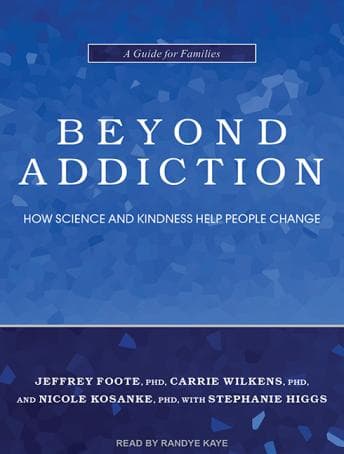
Beyond Addiction is basically cognitive behavioral therapy but for the family members of people struggling with substance use. The core argument: the intervention-and-tough-love industrial complex (my words, not theirs) is not only unscientific, it actively damages relationships and outcomes. Instead, the authors - four PhDs from the Center for Motivation & Change in New York - lay out a system grounded in motivational interviewing and positive reinforcement.
Think of it like this: if tough love is a brute-force algorithm that crashes half the time, this book is proposing an optimized approach with actual error handling. You learn to identify your loved one's motivational patterns, reinforce the behaviors you want to see more of, and - here's the hard part - stop accidentally reinforcing the destructive ones. There are concrete exercises throughout, like mapping out your own reactions to a loved one's drinking and identifying which of YOUR behaviors are actually enabling vs. helping.
The science actually holds up. They cite real studies, reference CRAFT (Community Reinforcement and Family Training), and don't shy away from the messy reality that change isn't linear. One section walks through how to have a conversation about treatment that doesn't devolve into an argument - specific scripts, specific language swaps. "I noticed you seemed happier last Tuesday when you didn't drink" instead of "You always ruin dinner." Small shifts, big impact. That granularity is what separates this from the self-help books that could've been a blog post. The bar for 'dense enough to justify the runtime' is one I've applied elsewhere too — Gleick's Isaac Newton is another one that earns every minute by refusing to dumb down the material.
The Narrator Problem (Let's Talk About It)
Okay, so. Randye Kaye. This is where it gets complicated. Her delivery has this very specific energy - warm, measured, almost therapeutic in itself. Which sounds great in theory. But at 6AM on a packed Caltrain, there were moments where her tone tipped from "compassionate guide" into "kindergarten teacher explaining sharing." I can see why some listeners flag it as condescending. It's not constant, but it's there - especially in sections that are more instructional, where the pacing slows and the vocal register gets a little too gentle, like she's worried you might break.
At 1.5x speed, this smoothed out considerably. The slightly syrupy quality compresses into something more natural, more conversational. I'd actually recommend 1.25x minimum for anyone who finds straightforward narration irritating at normal speed.
The bigger issue: this is a 12-hour book with exercises and worksheets that reference a companion workbook. On audio, you lose the ability to pause and fill things in easily. I ended up bookmarking probably 15 sections to revisit in print. If you're the target audience - desperate, overwhelmed, probably not sleeping great - the audio format is accessible but incomplete. You'll want the physical book eventually.
Who This Is Actually For (Be Honest With Yourself)
Perfect for: commute, dedicated listening sessions. Skip for: background, gym.
This is not a casual listen. It requires focus, and it requires emotional bandwidth. If you're a family member or close friend of someone with addiction issues and you've been told to "let them hit rock bottom" or "stop enabling" without any actual tools for what to do instead - this is your book. It's the first resource I've encountered that treats family members as agents of change rather than helpless bystanders or, worse, part of the problem.
If you're looking for memoir-style addiction stories or dramatic recovery narratives, this isn't it. It's a clinical guide wearing a friendly sweater. The humor the description promises is there but subtle - more "knowing nod" than laugh-out-loud.
One thing that stuck with me: the authors explicitly address the guilt and shame that family members carry. There's a section about how society basically sets families up to fail by giving them exactly two options - enable or cut off - and then blames them no matter which one they choose. Reading that part (well, listening to it, somewhere around Hillsdale station), I understood something about Kevin's mom that I hadn't before.
The Commit Message
I'm giving this to Kevin this weekend. Not the audiobook - the print version, because those exercises matter. But the audiobook got me through the content fast enough to know it's worth his time. It's not perfect. The narration is a mixed bag, the audio format loses some of the workbook utility, and at 12 hours it could probably be tighter by two. But the framework is sound, the science is real, and if it changes even one interaction between Kevin's family and his brother, that's worth way more than an Audible credit.