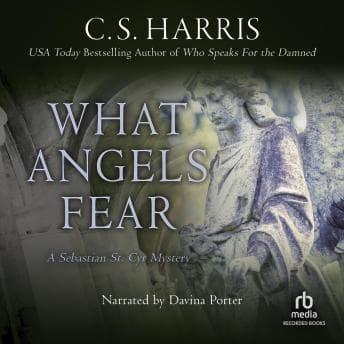

I was making dal makhani at 11 PM—the kind of elaborate cooking I do when my brain won't stop churning through something—when Sebastian St. Cyr first appeared in my ears. A nobleman accused of murder, shattered by war, running through Regency London's underbelly. The protagonist exhibits classic trauma response patterns, and I found myself stirring the lentils slower, genuinely curious whether C.S. Harris understood the psychology she was playing with.
She does. Mostly.
A War-Broken Mind in a Corset-Era Mystery
What makes Sebastian compelling is that his PTSD isn't window dressing. His hypervigilance, the way he reads rooms and people with that particular intensity survivors develop—it tracks. The research actually shows that combat veterans often develop heightened threat detection, and Harris uses this as Sebastian's investigative superpower without romanticizing the cost. He's not brooding for aesthetic purposes. He's genuinely fractured.
The 1811 setting works beautifully here. England during the Napoleonic Wars, revolution anxiety simmering beneath aristocratic propriety, a young woman murdered in a church near Westminster Abbey. Harris has a PhD in nineteenth-century Europe and it shows—not in tedious exposition dumps, but in the texture of how characters move through their world. The class tensions feel lived-in rather than lectured.
But here's where I found myself asking: why does Sebastian really keep pushing forward? His motivation wavers in the middle sections. The pacing drags around hours 5-7, where the investigation feels like it's treading water. I'd finished my dal, moved to chai, and was genuinely considering speeding up the narration. A mystery needs momentum, and this one occasionally forgets that.
The Davina Porter Problem
Let's talk about the elephant in the Regency drawing room. Davina Porter is an exceptional narrator—I've heard her Outlander work and she's brilliant there. But casting a female narrator for a male protagonist in his thirties creates a cognitive dissonance that never fully resolves.
Her Sebastian sounds... off. Not bad, exactly, but perpetually unconvincing. She's doing excellent technical work—her pacing is measured, her emotional delivery genuine, and she differentiates between the supporting cast effectively. The women characters come alive. The various London types—servants, aristocrats, street informants—each get distinct treatment.
But every time Sebastian speaks, my brain hiccups. My therapist would have thoughts about this character, but I couldn't fully engage with them because the voice kept pulling me out. It's like watching a brilliant actor miscast in a role—you can see the skill, but the fit is wrong.
Some listeners apparently pushed through and stopped noticing. I never quite did. And there's an inconsistency issue too—occasionally I'd lose track of who was speaking because character voices would blur together. Not constantly, but enough to require rewinding.
Who Should Listen (And Who Should Run)
If you love historical mysteries with genuine period atmosphere and psychological complexity, this is worth your time. Harris writes smart, research-grounded fiction that doesn't talk down to readers. Sebastian is a fascinating case study in how trauma shapes perception—and how it can be weaponized for survival. Gone Girl explores similar territory—how damaged psyches can become investigative tools, though in a contemporary setting with far more unreliable narration.
If you're particular about narrator-protagonist matching, or if you're planning to listen while doing something else, reconsider. This requires focus. Background listening will leave you confused about plot points and character relationships. I tried switching to commute listening and had to rewind repeatedly.
The violence is present but not gratuitous. There's sexual content—period-appropriate, not explicit. Mad Honey handles similar content warnings with the same restraint—violence that serves the mystery rather than exploiting it. Content warnings for both, though neither felt exploitative.
My Clinical Notes
This is a fascinating case study in what happens when excellent writing meets imperfect audio casting. The book itself? Genuinely good historical mystery with psychological depth that doesn't insult your intelligence. Harris knows her history and her human nature. Sebastian St. Cyr is the kind of protagonist I'd analyze in a research paper—complex, consistent, believably damaged.
The audiobook experience? Compromised. Not ruined, but compromised. I'll probably read the sequel in print, which tells you something.
If you've got an Audible credit burning a hole in your pocket and you're not picky about narrator matching, wait for a sale. If you're a historical mystery devotee who can adapt to unconventional casting, it's worth the commitment. If voice matching matters to you as much as it does to me—find the print edition and save yourself the cognitive friction.
The dal turned out excellent, by the way. The audiobook? Promising ingredients, slightly off execution.