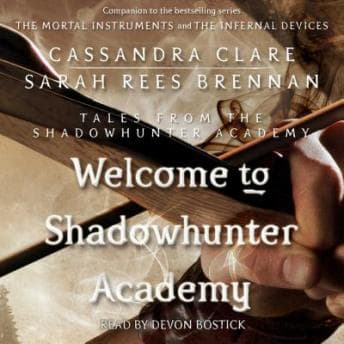

"Simon Lewis never thought he'd become a Shadowhunter." That line hits about three minutes in, and Devon Bostick delivers it with this perfect blend of exhaustion and disbelief that I recognized immediately - it's the same tone my juniors use when I tell them we're reading another Shakespeare play.
I'm going to be honest with you. I'm a forty-something English teacher who's spent two decades with Austen and Faulkner and Hemingway. The Shadowhunter universe is not my natural habitat. But my wife Denise left this queued up on our shared Audible account after she binged the whole Mortal Instruments series, and I was waiting in the parking lot of the mechanic's shop with nothing else loaded. So here we are.
Simon Lewis Is Every Kid Who Doesn't Know Where He Belongs
Here's what caught me off guard: underneath the Shadowhunter mythology and the YA scaffolding, this is a story about identity after loss. Simon's had his memories stripped. He's walking into a place where everyone knows who he used to be, and he has no idea. That's genuinely compelling territory. Clare and Brennan (the actual co-author, though Maureen Johnson gets the cover credit - publishing is weird) understand that the scariest thing about starting over isn't the new place. It's everyone else's expectations of someone you don't remember being.
The Academy itself functions like every boarding school story you've ever read - the hostile upperclassmen, the institutional food, the sorting of students into those who matter and those who don't. The "dregs" designation for mundane-born students hit a little close to home. I teach at a school where kids get sorted by test scores into tracks, and let me tell you, they feel that hierarchy in their bones. That same bone-deep awareness of class and belonging is what made American Marriage linger with me long after I finished it — Taylor and Roy carry a different kind of social weight entirely, but the way that weight warps identity from the inside? Clare and Jones are working the same nerve. Clare knows this. She's not subtle about it, but she doesn't need to be.
Bostick's Simon Sounds Like He's Barely Holding It Together (In the Right Way)
Devon Bostick - and I had to look this up, he's an actor, not a career narrator - does something interesting with Simon's internal monologue. There's a slight upward inflection at the end of Simon's thoughts, like everything is half-question. It gives you the sense of a guy who's perpetually unsure whether he's in on the joke or IS the joke. For a character rebuilding himself from scratch, that vocal choice works.
Where it gets uneven: the supporting cast bleeds together a bit. When guest characters from the broader Shadowhunter universe show up - Jace, Magnus Bane - Bostick shifts his register, but if you're not already familiar with these people (I wasn't), the distinctions are subtle enough that you might lose track. There's a moment during what I think is a Jace scene where the voice drops into this sardonic register that actually landed well, but I wouldn't have known it was Jace without context clues.
Also - and this is a minor thing - there are a couple of pronunciation stumbles on proper nouns from the Shadowhunter lore. The kind of thing fans will catch and non-fans won't notice. I'm in the "didn't notice" camp, but I've read enough listener complaints to flag it.
The One Hour and Forty Minute Problem
Let's talk about what the author is really saying with this format. At 1 hour 40 minutes, this isn't an audiobook. It's an episode. And that's both the appeal and the frustration. You get setup - Simon arrives, Simon discovers the Academy's class system, Simon starts to reckon with his lost past - and then it just... stops. Not a cliffhanger exactly, but the kind of ending that assumes you're going to immediately buy the next installment.
This is Part 1 of 10. It's a serialized experience priced and packaged as standalone stories. If you know that going in, fine. If you don't, you'll feel cheated. My students would call this "the Netflix pilot problem" - it exists to hook you, not to satisfy you. And it does hook you. I'll give it that.
The pacing reflects the brevity. There are stretches where we're sitting with Simon's confusion that feel appropriately uncomfortable, and then suddenly we're racing through introductions and world-building that needed more room to breathe. For a story about adjustment and disorientation, the rushed sections undercut the theme.
Who Gets the Most Out of This
If you've read The Mortal Instruments and you love Simon Lewis, this is a no-brainer. The emotional payoff of watching him navigate a world he used to know - that's fan service in the best sense. If you're new to Clare's universe, this is a rough entry point. Too many references assume prior knowledge, and the short runtime means there's no space for the kind of exposition a newcomer needs.
For audiobook listeners specifically: Bostick is solid if imperfect. He's got good comedic timing - there's a bit about Academy food that made me actually laugh in the mechanic's waiting room - and he handles Simon's vulnerability without overdoing it.
Worth Pausing the Faculty Meeting For?
Not quite. But worth the oil change wait? Absolutely. It's a snack, not a meal. A well-made snack with some genuine emotional protein in it, but you'll be hungry again in an hour. The prose deserves to be savored at 1.0x, even at this length - Bostick's delivery rewards patience. Just know what you're buying: an opening chapter sold as a short story, with nine more installments waiting in the wings.