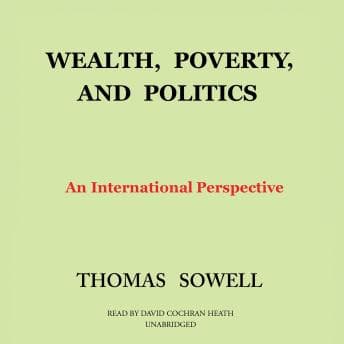

Why do some nations prosper while others stagnate? And more importantly—why do we keep getting the answer wrong?
I was on a three-hour drive to a client site in Houston, the kind of flat Texas highway that gives you nothing but time to think. Sowell's book landed in my ears at exactly the right moment. After 25 years in the Army watching foreign aid money evaporate into corruption and cultural black holes, I've got some strong opinions about what actually creates wealth. Turns out Sowell's been thinking about this a lot longer than I have—and with considerably more data.
The Briefing Nobody Wants to Hear
Let me cut to the chase: this isn't a comfortable listen. Sowell systematically dismantles the comfortable narratives that both sides of the political aisle have been selling for decades. Geography matters. Culture matters. Demography matters. And none of these factors care about your feelings or your policy preferences.
The man spends considerable time on something most economists conveniently ignore—the difference between wealth distribution and wealth production. It's like the difference between dividing up the rations and actually growing the food. I've seen this scenario play out in real life across three continents. You can redistribute all you want, but if the underlying conditions for wealth creation aren't there, you're just rearranging deck chairs. 48 Laws of Power touches on similar patterns of success across different cultures, though Greene focuses more on individual strategy than systemic analysis.
Sowell draws from an impressive international dataset—German immigrants in Brazil, Chinese minorities in Southeast Asia, Jews in various hostile environments throughout history. The patterns he identifies aren't politically convenient for anyone, which is probably why this book gets ignored in the places it should be required reading.
When the Narrator Becomes Background Noise
David Cochran Heath delivers Sowell's arguments with clarity. I'll give him that. But here's the problem—the narration is crisp and concise to the point of being almost mechanical. For a book packed with controversial arguments and provocative data, the delivery is oddly flat. Like having a brilliant professor who speaks in complete monotone.
At 1.25x speed (my standard), Heath's slightly robotic delivery actually works better. The faster pace adds some energy that the baseline performance lacks. But I found myself occasionally zoning out during the denser statistical sections—not because the content was boring, but because the narration didn't signal when something important was coming. No vocal emphasis, no subtle shift in tone. Just steady, methodical delivery.
For an 8.5-hour economics lecture, you need a narrator who can inject some life into the data. Heath gets the job done, but barely.
Decades of Homework Behind Every Argument
Sowell's greatest strength is his refusal to accept easy answers. He takes on Piketty, Krugman, and the entire progressive economic establishment with actual data rather than ideology. But he's equally hard on conservatives who want to blame everything on government interference while ignoring geographic and cultural factors that predate any modern policy.
The section on how mountain geography consistently correlates with poverty across every continent and culture—that's the kind of analysis that sticks with you. It's not about race, it's not about politics, it's about the fact that you can't build trade networks through the Swiss Alps or the Appalachian Mountains as easily as you can across the plains of Northern Europe.
Where this book lost me occasionally was in the pacing. Some sections feel laborious—Sowell hammers the same point with example after example until you're begging him to move on. I get it, Thomas. The data supports your thesis. Let's advance to the next objective.
Who Should Deploy This (And Who Should Stand Down)
If you want your economic assumptions challenged—genuinely challenged, not just confirmed—this is worth your time. Automatic Millionaire operates on a much smaller scale (personal wealth building rather than national economics) but it's another book that cuts through the noise with practical reality. Business owners, policy wonks, anyone who's ever wondered why foreign aid seems to accomplish nothing—you'll find value here.
Skip this if you want easy answers or if you're looking for ammunition to confirm what you already believe. Sowell doesn't play that game. He's going to make you uncomfortable regardless of your political tribe.
After-Action Report
Worth your time? Here's the debrief: Sowell delivers a rigorous, data-driven analysis that most people desperately need to hear. The narrator is adequate but uninspiring—you're here for the content, not the performance. At 8.5 hours, it's a significant commitment, but the intellectual payload justifies the investment.
Ranger slept through most of it, but he's more of a fiction guy. I'm adding Sowell to my regular rotation.