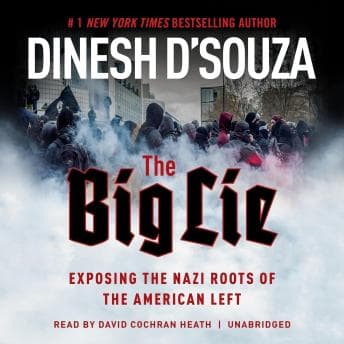

"The great masses of the people will fall for [a lie] precisely because of how bold and monstrous the lie is."
That line hit me while I was stuck in traffic on I-35, Ranger panting in the backseat. D'Souza opens with the heavy artillery. He doesn't do warning shots. I've spent twenty-five years in the military, dealt with propaganda from every angle, but this book? It comes out swinging like it's in a bar fight.
I picked this up because I was tired of the usual "both sides" waffle I get from cable news. I wanted a strong argument. Well. I got one.
The Calm Voice in a Firefight
Here's the contrast that threw me off—in a good way. Dinesh D'Souza writes like he's fixing a bayonet. The text is aggressive, polemical, designed to provoke. But the narrator, David Cochran Heath? The guy sounds like he should be reading a bedtime story or a classic novel.
(And honestly, thank God for that.)
If Heath had matched D'Souza's intensity, I would've turned it off at Chapter 2. My blood pressure can't take nine hours of screaming. Instead, Heath is professional. Respectful. He delivers these absolute grenades of accusations with the calm demeanor of a seasoned diplomat. Reminds me of those calm radio operators you hear in combat footage—the situation is chaotic, but the voice on the comms is steady. Makes the pill easier to swallow, even if you don't agree with the prescription.
When History Gets Weaponized
I consider myself a history buff. Especially regarding the mid-20th century. I've read Shirer, I've read the tactical breakdowns of the European theater. I've also read Zookeeper's Wife: A War Story, which covers the same era but from a completely different angle—one that focuses on humanity instead of ideology. D'Souza isn't writing that kind of history. He's doing what we call "intelligence analysis with a pre-determined conclusion."
He argues that the Democrats—not the Right—are the spiritual successors to the Nazis. It's a massive claim. A "Big Lie" reversal, as he puts it.
Does he make his case? Sometimes. He pulls on threads about early Democratic history, slavery, and segregation that a lot of modern textbooks conveniently gloss over. (The author clearly did his homework on the ugly parts of the 19th century). But then he takes a leap. He connects dots that are miles apart. Draws straight lines through very crooked history.
This feels different from other political books I've listened to recently. Most are memoirs or "why I'm great" vanity projects. This is a prosecution. He's building a legal case against an entire political party.
Who's This Briefing For?
If you're a conservative who wants ammunition for arguments, you'll find plenty here. If you're a liberal willing to have your assumptions challenged (even if you end up disagreeing), there's value in understanding how the other side builds its case. But if you want neutral, academic breakdown of political philosophy? You're in the wrong AO. Skip this one.
Mission Complete
I listened at 1.25x speed because D'Souza can get repetitive—he likes to hammer the nail even after it's flush with the wood. But I didn't zone out. It made me argue with my dashboard. Made me Google things at stoplights (don't tell Linda).
Ranger slept through the economic theory sections, but I stayed awake. Whether you buy his thesis or think he's crazy, you can't say it's boring. It's a provocative briefing, even if you have to verify the intel yourself.






![Steve Jobs [unabridged audiobook] audiobook cover](/_next/image?url=https%3A%2F%2Fcovers.audiobooks.com%2Fimages%2Fcovers%2Ffull%2F9788499923406.jpg&w=1920&q=75)