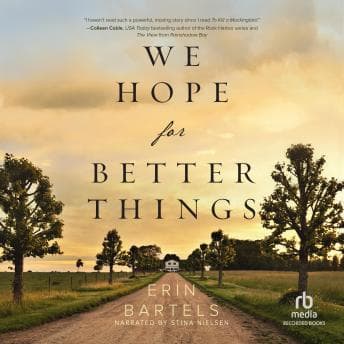

This book almost lost me in the first hour.
I'll be honest. I started We Hope for Better Things during Sophie's nap, and the timeline jumps had me so turned around I actually paused it and Googled whether I'd accidentally started in the middle. Three timelines — present-day Elizabeth, 1960s Detroit, Civil War-era Michigan — all woven through the same Michigan farmhouse, and in audio format with a single narrator, it's a lot to track when you're also listening for a toddler who treats naps like suggestions.
But here's the thing. I stuck with it. And by the time I was sitting in my car in the garage that night — the sacred 45 minutes, don't judge — I didn't want to go inside.
The Timeline Thing Is Real But Worth Pushing Through
So the complaints you'll see about this audiobook are valid. The three storylines share a location but span roughly 150 years, and Stina Nielsen doesn't do wildly different voices for each era. Her approach is more about emotional tone and pacing — she gets quieter, more measured during the Civil War sections, and there's a tension in her voice during the 1960s Detroit scenes that's different from the present-day journalist stuff. It works once your ear adjusts. But that adjustment takes maybe 90 minutes, and if you're pausing constantly for kid emergencies (yogurt incident, sibling tribunal, lost shoe — the usual), you might need to replay some early chapters.
I did. Twice. No shame.
Once you settle in though, the structure actually becomes the best part. Elizabeth shows up at her great-aunt Nora's farmhouse to deliver old photographs, and Nora is this stubborn, secretive old woman living alone with locked rooms and an overgrown cemetery on the property. Elizabeth starts digging into family history and we get pulled back — way back — and forward again to the riots of '67 in Detroit. The farmhouse is the anchor for all of it, and Bartels uses it well. You start to feel the weight of what happened in those rooms across generations.
When the Pieces Click Into Place
I'm not going to pretend this is a light beach read. It deals with the Underground Railroad, interracial marriage during the Civil War, the Detroit riots, and the ways families bury their worst secrets alongside their best intentions. There were moments — particularly when the connections between the three timelines started becoming clear — where I just sat in the school pickup line with my mouth open. The reveals aren't twisty in a thriller way. They're more like slowly realizing that the pattern you've been staring at is actually a picture of something heartbreaking.
Nielsen handles the emotional weight without overselling it. She doesn't do big dramatic shifts — it's more like she trusts the material and gets out of its way. Her reading of Nora especially has this quiet stubbornness that made me think of my own grandmother, the way older women can hold pain so still it looks like peace.
At 12 hours, this is longer than my usual comfort picks. I finished it in about nine days, which for me is practically a speed read. The middle third — where you're fully invested in all three timelines — flew by. I burned through two hours during a rainy Saturday when the kids were watching Bluey for the 400th time and I put in my earbuds and pretended I couldn't hear them.
The Faith Element (A Quick Note)
This is published by Revell, which is a Christian imprint, and yes there's a faith thread running through it. It's not preachy — no altar calls or conversion scenes — but it's there in the way the characters process forgiveness and hope. If that's a dealbreaker for you, fair enough. For me it felt organic to the story and the time periods. These are characters whose faith is tangled up with their survival in ways that felt honest rather than prescribed.
Made Me Cry at Pickup. Worth It Though.
Okay so I need to warn you: the ending got me. Not ugly-cry exactly, but my eyes were doing that thing where you're blinking really fast and pretending it's allergies while Emma's teacher waves at you through the car window. The way the three timelines converge and the family secrets finally surface — it earned its emotional payoff. Bartels spent 12 hours laying groundwork and the landing stuck.
This isn't a romance in the traditional sense, though love stories run through every timeline. It's more of a family saga disguised as a mystery disguised as historical fiction. If you loved The Kitchen House or The Invention of Wings, this lives in that neighborhood. I'll be real though — neither of those quite scratched the same itch as Story of Joan of Arc did for me when I wanted historical fiction with a woman at the center holding impossible weight across impossible circumstances.
Not recommended for background listening — you will get lost. But perfect for dedicated car time or nap time when you can actually focus. Survived my 47 pauses and still made sense, but only after I committed to really listening during that first hour.
My book club would love this. If I ever have time for book club again.