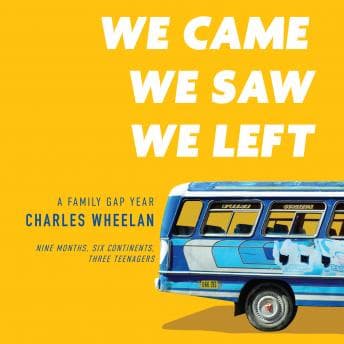

Ten hours of my life listening to a guy describe how he took his family on a gap year. My parents never took a vacation. Not one. They worked the dry cleaning business six days a week, fifty weeks a year, for decades. So when I see a book about a family that just... quits everything to travel the world? I have complicated feelings.
But here's the thing—Charles Wheelan knows he's privileged. He doesn't pretend otherwise. And the book is actually useful if you strip away the "look at our adventure" veneer.
The Business Case for Chaos
Wheelan's a Dartmouth professor, so you'd expect some intellectual heft, and he delivers. The logistics sections are genuinely valuable—how they budgeted, what they planned versus what actually happened, the real costs nobody tells you about. This is what my parents did instinctively. Now it has a TED talk. Except their version was "how to survive immigration and build a business from nothing," not "how to sneak out of a Peruvian town barricaded by the army."
The family dynamics stuff? That's where it gets real. Three teenagers. Nine months. Six continents. I've seen easier mergers. Too Much and Never Enough explores family dysfunction under pressure with higher stakes and worse outcomes. Wheelan doesn't sugarcoat the fights, the sulking, the moments when everyone wished they'd just stayed home. Jenny would say I'm being harsh. Jenny is right. But the honesty about how hard it is to travel with family—that's worth something.
P.J. Ochlan: Award-Winner on Autopilot
Okay, so P.J. Ochlan. The guy's won Audies. He's won Earphones Awards. He's clearly talented. But this particular performance? It's... flat. Some listeners literally thought it was AI narration. That's not a compliment.
I listen at 2.0x because time is money and most business books have 45 minutes of insight padded into 8 hours. My 2.0x speed couldn't save this one from feeling monotone. Ochlan reads clearly—no complaints there—but there's no energy shift when Wheelan's being funny versus when he's being serious. It all comes out at the same emotional register. For a book that's supposed to be "insightful and often hilarious," the narration doesn't sell the hilarious part.
I kept it on during my morning commute anyway. Clear enough to follow, professional enough to not annoy me. But I wasn't leaning in.
The 80/20 on This One
About three hours of content justifies the ten-hour runtime. Here's what actually matters:
The practical travel stuff—budgeting, planning, what goes wrong—that's gold. The flesh-eating bacteria story? Terrifying and useful (check your kids for weird rashes, apparently). The sections on local politics and economics in the countries they visit—Wheelan's background shows here, and it's legitimately interesting.
What you can skip: the repetitive "aren't we lucky" moments, some of the teenage drama that feels like padding, and honestly any section where you can feel him reaching for profundity.
Who Gets Value Here (And Who Doesn't)
If you're planning a similar adventure or curious about the logistics of stepping off the treadmill for a while—yes, worth your time. If you're looking for pure entertainment or can't stomach privilege-awareness that still reads as privilege? Skip it.
This is a solid travel memoir with real business insights buried in it. Not transformative, but practical. My parents would've appreciated the hustle mentality, even if they'd roll their eyes at the premise. "You took a year off? Must be nice." Yeah. Must be. Becoming has that same tension between privilege and hard work, though Michelle Obama earned her platform in ways Wheelan never had to.
Sample first though. That narration is going to work for some people and absolutely not for others. I stuck it out, but I was multitasking through about half of it.






![Steve Jobs [unabridged audiobook] audiobook cover](/_next/image?url=https%3A%2F%2Fcovers.audiobooks.com%2Fimages%2Fcovers%2Ffull%2F9788499923406.jpg&w=1920&q=75)