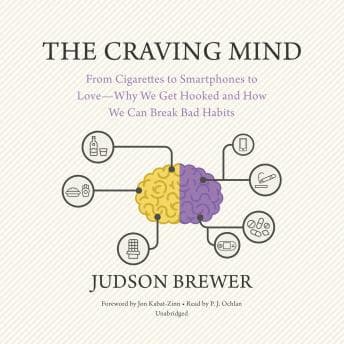

Look, I need to start with a complaint. Dr. Judson Brewer spends a solid chunk of this book explaining the habit loop — cue, behavior, reward — and I'm sitting there in my kitchen, stirring dal that I've made approximately four hundred times using my mother's recipe, and I realize I am literally performing a habit loop while listening to a book about habit loops. The meta-awareness was almost too much. I had to set down the ladle.
But here's where it gets interesting — and where my psychology brain started firing on all cylinders.
The Feedback Loop That Actually Loops Back on You
Brewer's central argument is elegantly simple, maybe too simple for some readers: mindfulness isn't just a wellness buzzword, it's a mechanism for interrupting the reward-based learning that drives addiction. He walks through how the same dopaminergic pathways that got our ancestors to seek food now have us refreshing Instagram at 2 AM. The protagonist here — and yes, I'm treating Brewer as a character in his own narrative because that's what I do — exhibits classic researcher-who-became-the-subject energy. He's not just studying addiction from his lab at UMass Medical School; he's examining his own patterns of craving and reactivity. That self-awareness gives the book a grounding that a lot of self-help lacks.
What I found genuinely useful was his chapter on addiction to overthinking. I found myself asking: why does Brewer frame rumination as an addiction rather than a symptom? And his answer — that the brain treats the feeling of "working on a problem" as its own reward, even when the thinking is circular and unproductive — psychologically, this tracks hard. The research actually shows that our brains don't distinguish well between productive analysis and anxious mental spinning. My therapist would have thoughts about this chapter. Specifically, she'd probably highlight it and hand it to me with raised eyebrows.
The Lance Armstrong chapter is another standout — Brewer uses Armstrong's description of flow states while mountain biking to explore the difference between getting hooked on the high of an experience versus being genuinely present in it. It's a fascinating case study in how even "positive" absorption can become another form of craving if you're chasing the feeling rather than inhabiting the moment.
Where the Science Holds and Where It Gets Thin
Brewer is at his best when he's weaving patient stories with clinical data. The book is strongest in its first half, where the neuroscience is tight and the examples — cigarette smokers, stress eaters — are concrete enough that you can feel the craving cycle in your own body. By the second half, though, the mindfulness prescription starts to feel repetitive. "Notice the craving. Get curious about it. Let it go." Yes, but — how many times can we restate the same mechanism before we're just... performing the habit of explaining habits?
This is an 8-hour-19-minute listen, and honestly, the argument could've been made in six. The pacing drags in spots, particularly when Brewer recounts meditation retreat experiences that feel more like personal journaling than structured argument. I don't mind personal narrative in science writing — I actively prefer it — but it needs to earn its space by advancing the thesis, not just illustrating the author's spiritual growth.
That said, the framework is solid. As someone who studies how people construct identity through narrative, I was struck by Brewer's implicit argument that we are the stories we tell ourselves about our cravings. The smoker who says "I'm a smoker trying to quit" is reinforcing the identity. The smoker who notices the craving with curiosity — without the narrative overlay — has a better shot at freedom. That's not just mindfulness. That's narrative psychology in action. The identity-construction angle actually reminded me of something I kept circling while reading 100 Ways to Overcome Shyness — the way we narrate ourselves into corners, and how the story we carry about who we are can be more addictive than any behavior it produces.
The Narrator Problem (And It Is a Problem)
P.J. Ochlan is an Audie Award winner, which makes this performance genuinely confusing. His delivery here is flat. Not calm-and-measured flat, but monotone in a way that strips the material of its natural warmth. Brewer's writing has personality — dry humor, self-deprecation, genuine compassion for his patients. Ochlan's reading irons all of that out into a steady, almost robotic cadence. One listener compared it to a Speak & Spell machine, and while that's harsh, I understand the impulse. During my morning jog through Cambridge, I kept having to actively re-engage because the narration was lulling me into exactly the kind of autopilot the book warns against. Ironic? Painfully.
I'd recommend bumping the speed to 1.25x. It doesn't fix the inflection problem, but it at least keeps the pacing from becoming its own sedative.
Who Gets the Most Out of This
If you're someone who's read the pop-science habit books — Duhigg, Clear — and wants to understand the why beneath the behavioral hacks, Brewer goes deeper into the neuroscience and offers a different toolkit. If you're already a mindfulness practitioner, parts of this will feel like preaching to the converted. If you need a narrator with energy and warmth to carry you through nonfiction, read the print version. Seriously. The content deserves better audio treatment than it got.
My Clinical Assessment
The Craving Mind is a good book trapped inside a mediocre audiobook. Brewer understands human nature — specifically, the way our brains betray us by rewarding the very behaviors we're trying to escape. The science is credible, the framework is actionable, and the self-awareness is refreshing. But the narration actively works against the material, and the second half needed a sharper editorial hand. I'd recommend it to anyone interested in the intersection of neuroscience and contemplative practice — just maybe not in this format.