
This book is about the lie we tell ourselves when we say friendship transcends race.
I started listening on a Saturday morning, lakefront walk with Denise, and by the time we hit the turnaround point near Montrose Harbor, neither of us was talking. She had one earbud in - I'd shared the audio with her - and we just walked in silence for a while. That's a particular kind of power for a novel to have over two people who've been married twenty-three years and usually can't shut up about the neighbor's landscaping choices.
The Architecture of Two Women Refusing to Say What They Mean
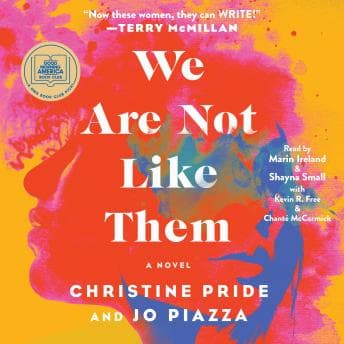
Pride and Piazza have done something structurally smart here that the audiobook format amplifies in ways the print version probably can't. Jen and Riley alternate chapters - childhood best friends, one white, one Black, now navigating the aftermath of Jen's police officer husband shooting an unarmed Black teenager. On the page, that's effective. In your ears, with Shayna Small voicing Riley and Marin Ireland voicing Jen, it becomes something closer to eavesdropping on two people having the same conversation in completely different languages.
Small's Riley carries this controlled professionalism - she's a TV journalist, and you can hear the broadcast cadence slipping in even during her most private moments, like she's narrating her own pain from behind a news desk. It's a character choice that tells you everything about how Riley has learned to survive in white spaces. Ireland's Jen, by contrast, sounds increasingly unmoored as the novel progresses. There's a tremor that creeps into her voice during the scenes where she's trying to defend her husband while knowing, somewhere underneath, that the defense doesn't hold. That vocal shift over eleven hours is genuinely impressive acting work.
Kevin R. Free and Chanté McCormick handle supporting roles - brief appearances, but well-placed. Free brings a particular weight to the male voices that grounds some of the heavier confrontation scenes.
What the Authors Are Really Saying (And What They're Brave Enough Not To)
Let's talk about what the authors are really saying. The title - We Are Not Like Them - works in about four different directions simultaneously, and the novel is smart enough to let you discover each one on your own timeline. Jen says it about her husband. Riley says it about white people. Both say it about each other. And the reader eventually realizes that the "them" keeps shifting depending on who's afraid of what.
This reminds me of what Hemingway said about the dignity of movement of an iceberg - what's above water is powerful precisely because of what's underneath. Pride and Piazza write the surface conversations between Jen and Riley with all the careful politeness of two people terrified of saying the wrong thing. But the internal monologues - the alternating chapters where each woman tells us what she's actually thinking - that's where the iceberg sits. Riley's private fury at being asked, again, to comfort the white woman. Jen's bewilderment that her pregnancy and her husband's potential prison sentence somehow make her the villain.
Now - is it perfect? No. There are moments, particularly in the middle third, where the novel's thesis gets a little too visible, where characters articulate their racial dynamics with the precision of someone who's read all the right books about racial dynamics. Real people in crisis don't always have that vocabulary. My students would call this "on the nose." They'd be half right. But the emotional truth underneath those moments is real enough that I kept walking and kept listening.
Who Needs to Hear This (Literally)
If you loved Tayari Jones's An American Marriage - and I know that comparison is on the back cover, but it's actually earned here - this is its spiritual successor in terms of examining how systemic forces crack open intimate relationships. Jones focused on a marriage; Pride and Piazza focus on a friendship, and in some ways that's even more gutting because friendships don't have the legal and social scaffolding that marriages do. When the foundation cracks, there's nothing structural holding you together. Just history. And history, this novel argues, might not be enough. I reviewed Little Men a while back and kept circling a similar idea — how the relationships we assume are permanent are actually just agreements we keep renewing, until one day we stop.
The four-narrator production is the right call for this material. A single voice would've collapsed the distance between these two women, and that distance is the whole point. You need to hear the gap between them widen.
Skip this if you want clean resolutions. The ending is honest, which means it's complicated, which means it'll sit with you for a while. Also skip if you need fast pacing - this is an eleven-hour character study, not a thriller. The prose deserves to be savored.
But if you're someone who's ever had a friendship where race was the elephant in every room - or if you've never had that experience and need to understand what it feels like from both sides - this is required listening.
The Assignment I'd Actually Give
I'm going to do something I almost never do and recommend this to my junior class. Not the audiobook - the school can't afford that - but the novel itself. Because the thing Pride and Piazza understand, the thing that makes this worth your eleven hours, is that good intentions are not the same as good actions, and love is not the same as understanding. My students already know this. Most adults are still catching up.