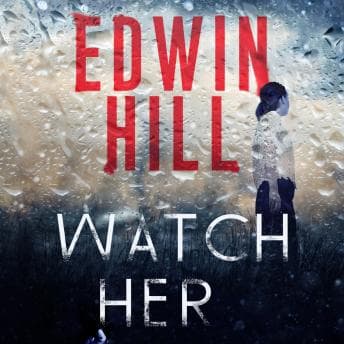

Look, I need to get something off my chest. If you're going to set a mystery at a for-profit university and build your plot around financial transgressions, missing alumni, and a family drowning in secrets - you better make me care about why any of it matters. Edwin Hill mostly pulls that off with Watch Her, but it took me a while to get there, and I'm still sorting out whether the journey was worth the destination.
I finished this one on a late-night drive back from a client site in San Antonio, the kind of empty highway stretch where your headlights feel like the only light left in Texas. Good setting for a mystery, actually. Ranger was asleep in the back seat and missed most of it. His loss.
A Librarian-Detective I Didn't See Coming
Hester Thursby is not your typical mystery protagonist, and I mean that as a genuine compliment. She's a researcher - a reference librarian by training - and Hill uses that skillset as her primary weapon. No gun, no badge, just an obsessive ability to pull threads and follow data trails. When she starts digging into the Matsons' for-profit university, Prescott, the investigation feels more like forensic accounting than detective work. There's something satisfying about watching someone dismantle a wealthy family's facade using public records and alumni databases instead of car chases.
The setup at Pinebank - the Matsons' mansion on Jamaica Pond in Boston - is genuinely strong. Jennifer Matson calls in a break-in that doesn't add up, and from that single lie, the whole thing unravels. Hill layers the family's problems well: Tucker's wandering eye, Jennifer's defensiveness, financial problems at the university that smell like fraud, and a decades-old tragedy that nobody wants to talk about. When one of the missing students turns up dead, the stakes finally click into place.
But here's where it got complicated for me. The book takes its time - maybe too much time - building the web of relationships before the body drops. At 10 hours and 39 minutes, there are stretches in the middle where I felt like I was sitting through a briefing that could've been an email. The pacing picks up significantly in the back third, but getting there required patience I don't always have.
Karen White's Tightrope Walk
Karen White's narration is going to be divisive, and I can see both sides. Her character work for Hester is solid - there's a quiet intensity to her delivery that fits the researcher-protagonist well. She gives Angela White (the detective) a slightly harder edge that distinguishes her from Hester without going cartoonish. The Matson family members each get their own flavor: Tucker sounds like the kind of entitled CEO I've met at security briefings, all smooth confidence hiding nothing of substance.
But there's this undercurrent of anxiety in White's reading that I kept noticing. During scenes that should feel tense - and appropriately tense - she carries that same breathless, slightly-panicked energy into quieter moments too. A conversation over coffee shouldn't sound like someone's about to breach a door. It's not a dealbreaker, but by hour six, I was aware of it in a way that pulled me out of the story occasionally. If you're the kind of listener who latches onto vocal patterns, you'll notice it. If you're not, you'll probably think she's just keeping things urgent.
The Boston of It All
I'll give Hill this - the man knows his setting. Jamaica Pond, the university campus, the specific geography of Boston neighborhoods - it all feels lived-in rather than Googled. As someone who spent time at Fort Devens years ago and knows the area a bit, the details tracked. The for-profit college angle is clever too. Hill clearly did his research on how these institutions operate, how they exploit students, how the money flows. It gives the mystery real-world weight that a lot of thrillers skip over.
The Agatha Award nominations make sense to me now. This is a cozy-adjacent mystery with actual teeth - no graphic violence for shock value, but real consequences when they come. Hill respects the reader enough to let you figure things out alongside Hester rather than holding your hand or pulling cheap twists.
That said, the resolution felt slightly rushed compared to the deliberate buildup. After spending seven hours carefully constructing this house of cards, the final three hours knock it down almost too quickly. I wanted to sit with some of the revelations longer.
Who Gets the Green Light
If you like character-driven mysteries where the protagonist thinks her way through the case - think Tana French's approach but set in academic Boston - this is your lane. If you need bodies stacking up every chapter and a ticking clock, you'll be checking your remaining time by hour four. Left To Die scratches that faster-burn itch if you need something with more throttle and less patience required.
Debrief and Dismissal
Worth your time? Conditionally. Watch Her is a smart, well-constructed mystery that rewards patience but demands it too. Hill writes the kind of book where every detail matters, which is admirable until you're on a dark highway wondering when something's going to happen. Karen White's performance is more hit than miss, but that anxious undertone is real. I'd recommend this at 1.25x speed without hesitation - it tightens the pacing exactly where it needs it. Ranger slept through the whole thing, so no endorsement from him, but I'll be checking out the rest of the Hester Thursby series. That's about the best compliment I can give a mystery: I want to see what this character does next.