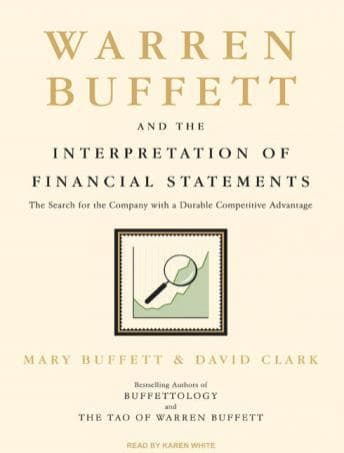

Three hours. This book is three hours. I want to shake Mary Buffett and David Clark's hands because they understand something most business authors don't: respect my time.
I've listened to enough bloated finance books to fill a semester. You know the type—12 hours of content that could've been a whitepaper. This one? Pure signal, minimal noise. My 2.0x speed wasn't even necessary, but old habits die hard.
The Buffett Decoder Ring
Here's what this book actually is: a translation guide. Warren Buffett reads financial statements the way my mom reads a restaurant menu—she knows exactly what she's looking for and ignores everything else. This book shows you what he's looking for.
The core concept is "durable competitive advantage"—basically, what makes a company impossible to kill. Buffett looks for businesses with consistent earnings, low debt, minimal R&D costs (because high R&D means you're constantly fighting to stay relevant), and fat profit margins that stay fat over time. None of this is revolutionary if you've read anything about value investing. But the way they break down the balance sheet and income statement line by line? Genuinely useful.
I've seen startup founders blow through millions because they didn't understand the difference between gross profit and operating profit. This book would've saved them. It's that practical.
The financial ratios section is where the real value lives. Return on equity, debt-to-equity, current ratio—they don't just define these terms, they show you Buffett's thresholds. What numbers make him interested versus what makes him walk away. That's the stuff you can actually use on a Monday morning.
Karen White's Professorial Approach
Karen White narrates this like she's teaching an intro finance course at a decent state school. Steady, clear, no drama. For this content? It works. You're not here for emotional peaks and valleys. You're here to learn how to read a 10-K filing without falling asleep.
That said—and I mean this kindly—there's zero personality. She sounds like she's reading a textbook because, well, she kind of is. The book has Buffett quotes and anecdotes scattered throughout, and I kept wishing they'd gotten someone to voice those with a little more warmth. Buffett himself is famously folksy and funny. That doesn't come through in White's delivery.
But honestly? For a three-hour educational audiobook, I'll take "clear and competent" over "trying too hard to be engaging." I've suffered through narrators who think they're performing Shakespeare when they're reading about EBITDA. This is better.
Where It Falls Short
Here's my issue: this book is from 2008. The examples are dated. The principles are timeless—Buffett's framework hasn't changed much—but when they reference specific companies, you're getting a snapshot from 15+ years ago.
Also, if you've already read The Intelligent Investor or any of Buffett's annual letters, about 40% of this will feel like review. The book positions itself for "newcomers and seasoned Buffettologists alike," but let's be honest—it's really for people who want to understand financial statements but find Graham's original work too dense. (Which, fair. Graham can be a slog.)
The authors also repeat themselves. "Durable competitive advantage" gets mentioned so many times I started counting. I get it—it's the central thesis—but three hours isn't that long. We don't need that much reinforcement.
Who This Is (and Isn't) For
Perfect for someone who wants to invest in individual stocks but has never really understood what they're looking at in a company's financials. If you've been buying index funds because picking stocks feels too complicated, this is a solid starting point. Also great commute material—each concept is bite-sized enough that you won't lose the thread if you zone out for a minute. I listened to most of it while driving to client meetings, and the information stuck better than I expected.
Skip it if you're already comfortable reading 10-Ks and annual reports. Skip it if you want current examples. And definitely skip it if you're looking for get-rich-quick strategies—Buffett's whole thing is patience, and this book reflects that. Who Moved My Cheese takes the opposite approach—it's all about adapting quickly, which has its place, but won't teach you how to read a balance sheet.
The ROI Calculation
This is what my parents did instinctively—they knew which businesses in Koreatown would survive and which would fold within a year. They just couldn't articulate why. This book gives you the vocabulary and the framework to do what good business people do naturally: identify companies that will still be standing in 20 years.
At three hours, it respects your time. At this level of practical detail, it respects your intelligence. That's more than I can say for 80% of the business audiobooks in my library. Is it exciting? No. Is it useful? Absolutely. Sometimes that's enough.