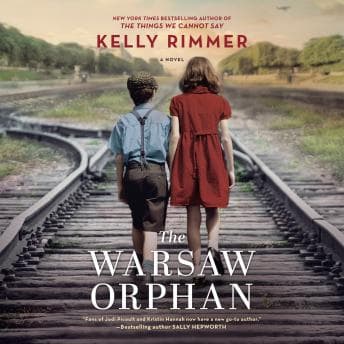

"I have no fondness for the Germans who patrol my streets." Elzbieta says something close to this early on, and Nancy Peterson delivers it with such careful understatement - not rage, not defiance, just this quiet, controlled acknowledgment - that I had to stop walking and stand still on the lakefront path for a moment. Because that's exactly how occupation works, isn't it? You learn to flatten your emotions into something survivable. And that single line told me Rimmer understood something fundamental about her subject.
The Teacher in Me Couldn't Stop Taking Notes
I teach Night every year to my juniors. Twenty years of watching sixteen-year-olds encounter the Holocaust for the first time. So I come to WWII historical fiction with both deep respect and serious skepticism - because the genre can so easily slide into exploitation, into using real suffering as set dressing for a love story. Rimmer walks that line carefully, and mostly stays on the right side of it.
The dual timeline structure follows Elzbieta, a young Polish woman hiding her own identity while smuggling Jewish children out of the Warsaw Ghetto, and Roman Gorka, a Jewish young man whose family faces the impossible calculus of giving up their newborn daughter to save her from starvation. What makes this work is that Rimmer doesn't rush the moral weight of those decisions. She lets them sit. Roman's family doesn't heroically sacrifice in one dramatic scene - they agonize, they argue, they grieve before the child even leaves their arms. That felt honest to me.
The book is inspired by Irena Sendler, the real Polish social worker who smuggled approximately 2,500 children out of the Warsaw Ghetto. Rimmer fictionalizes through the character of Sara, Elzbieta's neighbor, and the choice to observe Sendler's work through a secondary character's eyes was smart. It avoids the trap of turning a real hero into a fictional protagonist who has to serve plot mechanics. Sara remains slightly mysterious, slightly larger than the narrative frame, which is exactly how historical figures should feel in fiction.
If you loved The Things We Cannot Say - Rimmer's earlier novel - Elzbieta is actually connected to Emilia from that book. But this stands completely on its own. I hadn't read the earlier one and never felt lost.
Charlie Thurston Earns His Keep (Eventually)
Here's the thing about the dual narration: Nancy Peterson is immediately comfortable. She finds Elzbieta's voice right away - young but not naive, frightened but purposeful. There's a slight tremor she puts under certain lines when Elzbieta is lying about her identity that's just beautiful vocal work. The narrator understands that pause is punctuation, and Peterson uses silence like a scalpel.
Charlie Thurston as Roman? I'll be honest - for the first hour or so, his voice felt almost too polished for a starving young man in the ghetto. Something about the cadence felt rehearsed rather than desperate. And I know I'm not alone in this reaction. But here's what happened: as Roman's situation deteriorated, as hunger and rage and grief accumulated, Thurston's performance shifted. By the time Roman is drawn into rebellion - into the kind of reckless, furious resistance that comes from having nothing left to lose - Thurston had completely won me over. That initial smoothness started to read as Roman's dignity, the last thing he refused to surrender. Whether that was intentional or just happy accident, it worked.
The two narrators never share scenes in a full-cast style - it's clearly divided chapters - but the contrast between their voices creates its own kind of class geography. Peterson's Elzbieta exists in a world where there's still tea and conversation and the pretense of normalcy. Thurston's Roman lives behind the wall where that world has already ended. You feel the divide just in the audio texture.
When History Demands More Than a Love Story
My one real criticism: the romance. Not that it exists - love during wartime is absolutely legitimate territory. But the pacing of Elzbieta and Roman's connection occasionally felt like it was serving the genre rather than the history. There are moments in the middle third where the tension between them gets more narrative real estate than the children being smuggled to safety, and I wanted to grab Rimmer by the shoulders and say, "The rescue operations! Give me more of the rescue operations!"
The final act, though - from the Warsaw Ghetto Uprising through the postwar communist threat - hits hard. Rimmer doesn't give you the ending you want. She gives you the ending that history actually delivered, which is messier and more painful and more true. My students would hate this. I love it.
At 13 hours and 17 minutes, it's a proper commitment. I listened at 1.0x because the prose deserves to be savored, and because Peterson and Thurston are both doing the kind of interpretive work that gets lost at higher speeds. Content warnings for violence, abuse, and scenes involving children in danger that are genuinely difficult to hear.
Worth Pausing the Faculty Meeting For
This is why we still read about the darkest chapters of history - not because suffering is entertaining, but because someone like Rimmer can take a real story and make you feel the specific, individual weight of each life at stake. It's not perfect. The romance wobbles. The early pacing asks for patience. But by the end, standing in my kitchen at 11 PM with a stack of ungraded essays and tears I wasn't expecting, I knew this was the real thing.
If you loved All the Light We Cannot See or Leon Uris's Mila 18, this is their spiritual successor - quieter, maybe, but no less devastating. Listeners who need action-driven pacing or prefer lighter historical fiction should probably look elsewhere. I reviewed Braver a while back, and it sits in that lighter register — genuinely good, but a different animal entirely from what Rimmer is doing here. But if you want to understand what ordinary courage looked like in Warsaw in 1942, put your earbuds in and walk.