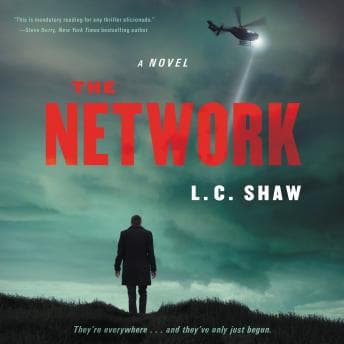

I need to talk about the love triangle problem in thrillers. You know the one. Our hero gets a call from someone in danger, and wouldn't you know it, the person they need to protect just happens to be The One Who Got Away. Jack Logan gets a panicked senator showing up at his door, begging him to protect his wife Taylor - who is, of course, the only woman Jack ever truly loved. I audibly groaned. In my kitchen. At 10 PM. While Shirley judged me from the counter.
But here's the thing. I kept listening. And I need to figure out why.
The Conspiracy Machine Runs Hot - Sometimes Too Hot
L. C. Shaw (who is actually Lynne Constantine writing under a pen name, which feels appropriate for a book about shadowy identities and hidden power structures) builds a conspiracy framework that's genuinely ambitious. The Institute - this sprawling facility that's been grooming America's political and media elite for decades - is the kind of big-swing concept that either lands or collapses under its own weight. It mostly lands? The tentacles-everywhere paranoia works because Shaw doesn't just tell you institutions are compromised; she moves the story through Congress hallways, Madison Avenue offices, and a remote Greek island to show the reach.
The problem is that the book only has one speed. And look, I get it - the blurb literally quotes Andrew Gross saying it "only has one gear: high." That's meant as a compliment. But at 9 hours and 43 minutes, relentless urgency starts to flatten out. When everything is a crisis, nothing feels like a crisis. I found myself craving a quieter moment where Jack and Taylor could just - breathe. Process. Be human beings instead of plot delivery devices. The dread never gets to build because we're always sprinting past it.
This is where my horror brain clashes with the thriller machine. I want the slow creep. I want to sit in the wrongness of a room before someone kicks the door in. Shaw isn't interested in that. She's interested in velocity, and if that's your thing, you'll eat this up.
Charlie Thurston Earns His Keep
The narrator commits. That's rare. Thurston does something I really appreciate in conspiracy thrillers - he calibrates his tension to the scene rather than just going full-throttle for ten hours straight. When the senator shows up at Jack's door in that opening scene, Thurston plays Phillips as desperate but coherent, not cartoonishly hysterical. It grounds the premise in something that feels real enough to follow.
His character differentiation is solid without being showy. Jack gets this steady, slightly worn quality - a journalist who's seen too much but can't stop looking. The antagonist side of things gets cooler, more measured reads. Damon Crosse, the Institute's leader, comes through as someone who genuinely believes he's the reasonable one in the room, which is way more unsettling than a mustache-twirling villain voice would've been.
Where Thurston really earns it is in the chase sequences. There are a lot of them (see: one gear, high), and he paces his breathing and cadence to create actual physical tension. I was doing dishes - just standing there with a sponge in my hand, not moving, because I didn't want to miss a line. That's a narrator doing his job.
The Plot Asks You Not to Think Too Hard
Here's where I got complicated feelings. The conspiracy is fun in a "movie on a plane" kind of way, but it wobbles when you poke at it. Taylor unknowingly holds the secret to the one thing Crosse needs - and the mechanics of why she has this information and doesn't know it require you to just... go with it. I went with it. But I noticed. The Greek island sequence is probably the strongest stretch because the physical isolation mirrors the paranoia, and Shaw's pacing actually benefits from a contained setting where the threats feel tangible rather than abstract.
The media manipulation angle is interesting conceptually but never gets as sharp as it could. For a book about who's really pulling the strings, the actual mechanisms of control stay pretty vague. I kept wanting Shaw to dig into the how - how do you shape a generation of power players? What does that indoctrination look like day to day? Instead we get the surface-level reveal and move on.
But - and this matters - the book is entertaining. I finished it. I didn't hate-finish it. There's a difference.
Who Gets the Most Out of This
If you love conspiracy thrillers that move fast and don't apologize for it - the Dan Brown lane, the James Rollins lane - this is a solid entry. If you're looking for psychological horror dressed in thriller clothing, this isn't it. If you want a narrator who takes the material seriously and elevates it, Thurston delivers.
Skip if you need your conspiracies to hold up under cross-examination. Lean in if you want a propulsive listen that keeps your hands busy and your brain engaged enough.
The Catalog Card
I'm not going to pretend this changed my life. But I'm genuinely curious about the sequel, The Silent Conspiracy, and that counts for something. Honestly, the only audiobook I've reviewed recently where the narrator felt equally load-bearing was Adventures of Huckleberry Finn - different century, different stakes, same thing where you realize the voice is doing half the storytelling work. Thurston's narration is the engine that keeps this running when the plot mechanics get creaky. My podcast listeners who like their thrillers breathless and their conspiracies sprawling? They'll have a good time. Shirley (my cat) was unimpressed. But she's unimpressed by everything that isn't Shirley Jackson, so.