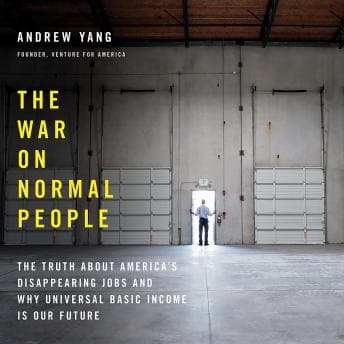

This book made me uncomfortable. And not in the way a firefight makes you uncomfortable - more like the way a good intelligence briefing does when the analyst lays out exactly how bad things are about to get and you realize nobody upstairs has a plan.
I finished Yang's book on a late-night drive back from a client site in San Antonio. Ranger was asleep in the back seat, the highway was empty, and Yang was calmly explaining how truck driving - the most common job in 29 states - is about to get automated into oblivion. That hit me. I've spent enough time in places like Fort Hood and the communities around it to know what happens when a town's primary employer disappears. Yang's not guessing. He's walking you through the math.
The Threat Assessment Nobody Wants to Read
Let me cut to the chase: the first half of this book is the strongest policy argument I've heard in audio form in a long time. Yang breaks down automation not as some sci-fi hypothetical but as an ongoing operation. He talks about what happened to manufacturing towns in the Midwest, what's already happening in retail, what's coming for call centers, food prep, and yes, trucking. He cites specific displacement numbers - 45 million jobs within twelve years - and then walks you through the downstream effects: opioid addiction, declining life expectancy, rising disability claims. It reads like a battle damage assessment.
What separates this from the usual political book is that Yang doesn't moralize. He doesn't blame people for being left behind. He comes at it like an engineer diagnosing a systems failure. His background running Venture for America - basically trying to create jobs in struggling cities - gives him ground-level credibility. He's not some Beltway think-tank guy theorizing from a conference room. He's been to Detroit, to Cleveland, to Baltimore, and he'll tell you exactly what he saw. That kind of ground-level credibility is rare in policy writing - I got a similar feeling from American Desperado, where the narrator's firsthand experience in systems most people only theorize about gives the whole thing a weight you can't fake.
Where the OpOrder Gets Fuzzy
The second half is where I started pushing back. Yang pivots to Universal Basic Income as basically THE solution - $1,000 a month to every American adult, no strings attached. He calls it the "Freedom Dividend." Look, I've managed logistics budgets for brigade-sized elements, and I understand the appeal of simple, direct solutions. But Yang rushes through the funding mechanisms and waves away some pretty serious objections. How do you prevent inflationary pressure? What about the political reality of getting this through Congress? He addresses these, but quickly, almost dismissively.
The book's at its weakest when Yang shifts from diagnostician to evangelist. The problem section is rigorous and data-heavy. The solution section feels more like a stump speech - which, given that he was gearing up for a presidential run, makes sense. But it undercuts the credibility he built in the first three hours.
Yang Behind the Mic
Here's something I didn't expect: Yang narrating his own book actually works. A lot of authors reading their own stuff sound like they're presenting a PowerPoint to a half-asleep boardroom. Yang sounds like he's talking to you over coffee. His delivery is conversational, pacing is solid, and he clearly believes what he's saying without getting preachy about it. At just under seven hours, it's a clean listen - I ran it at 1.25x and it tracked perfectly. No production issues, no weird audio artifacts. Just a guy making his case.
That said, he's not a professional narrator, and it shows in spots. There's a flatness to some of the statistical sections where a trained voice actor would've found ways to keep the energy up. Minor complaint, but by hour five I noticed my attention drifting during the policy prescription chapters.
Who Needs This Briefing
If you run a business, manage people, or just want to understand why so many American communities are falling apart, the first half alone is worth your time. I've been in security consulting long enough to know that the biggest threats are the ones people refuse to see coming. Yang does a solid job of making the invisible visible.
But if you're looking for a balanced policy debate with multiple perspectives and rigorous counterarguments - this isn't it. It's one man's diagnosis and one man's prescription. Take it for what it is.
Skip it if you can't separate policy analysis from partisan politics. Yang was a Democratic candidate, and some people will tune out on principle. Their loss, honestly. The automation data doesn't care about your voter registration.
Mission Debrief
Worth your time? Here's the debrief: strong recon report, adequate battle plan. I'm glad I listened. It changed how I think about some of the communities I drive through on the way to client sites - those boarded-up storefronts in small Texas towns aren't just economic casualties, they're early indicators of what Yang's warning about. The book won't change your politics, but it might change what keeps you up at night. Ranger slept through the whole thing, but I didn't.