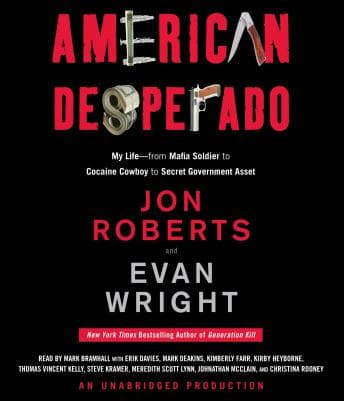

I have a problem with Jon Roberts. Not the audiobook—we'll get to that—but the man himself. Sixteen hours into his life story and I'm genuinely annoyed that I find him so fascinating. Because here's the thing: Roberts exhibits textbook antisocial personality disorder. The lack of remorse, the grandiosity, the shallow affect masked by charm. My therapist would have thoughts about this character. And yet I couldn't stop listening.
I finished this at 2 AM, stirring a pot of dal that I'd completely forgotten about because Mark Bramhall was describing how Roberts witnessed his first murder at age seven and processed it with the emotional depth of someone watching a mildly interesting nature documentary. The dal burned. I didn't care.
A Psychopath's Memoir Shouldn't Work This Well
The research actually shows that first-person accounts from individuals with antisocial traits are notoriously unreliable. They embellish, they self-aggrandize, they rewrite history with themselves as the clever protagonist. Roberts does all of this. He absolutely does. And Evan Wright—who wrote Generation Kill, so he knows how to handle morally complicated subjects—doesn't try to hide it. Instead, he builds a narrative structure that essentially says: here's what Roberts claims, here's what the evidence shows, make your own judgment.
What makes this character compelling is his complete lack of insight into his own pathology. Roberts describes killing people with the same casual tone he uses to talk about his 200-pound pet cougar. The full cast production amplifies this brilliantly. When other voices enter—witnesses, associates, people who were there—you get these moments of tonal whiplash. Bramhall's stern, composed delivery for Roberts sounds almost reasonable until another narrator provides context that makes your stomach drop.
Ten Narrators for One Memoir (It Works)
Sounds excessive. It's not. The transcriptions from various people build the story in layers—you'll hear Roberts make a claim, then immediately get someone else's perspective that either confirms or subtly undermines what he just said. It's like reading a case study where all the subjects are talking over each other.
Bramhall deserves the praise he gets. His Roberts is cool, almost detached, which is exactly right. A more dramatic reading would've turned this into exploitation. Instead, you get this unsettling calm that mirrors how actual psychopaths present in clinical settings. I've interviewed subjects like this for research. The flatness is accurate. Disturbingly so. That same unsettling authenticity drew me into Silent Patient, where the narrator's calm delivery masks something deeply wrong underneath.
The other narrators handle their roles competently—no one drops the ball, no jarring transitions between voices. For a production this complex, that's an achievement.
Why I'm Still Thinking About This Three Days Later
This is a fascinating case study in how we consume true crime. Roberts lived an objectively terrible life—Mafia connections, Vietnam atrocities, cocaine trafficking that destroyed countless families, possible CIA involvement (which, honestly, tracks with what we know about that era). The book doesn't moralize. It just... presents. And that's uncomfortable.
I found myself asking: why does Roberts really tell this story? He claims it's about truth, about setting the record straight. But the grandiosity, the name-dropping (Jimi Hendrix, Richard Pryor, O.J. Simpson, Carlo Gambino—the list reads like he's trying to impress you at a party), the almost gleeful recounting of violence—this is a man who wants to be admired for being a monster.
Psychologically, this tracks perfectly. And that's what makes it valuable, I think. Not as entertainment, though it is entertaining in a dark way. But as documentation of a particular kind of mind.
Who Should Subject Themselves to This
If you're interested in criminal psychology, the intersection of organized crime and government operations, or just want to understand how someone can commit atrocities and sleep fine at night—this is essential listening. If you need your true crime with a moral framework, with justice served, with some sense that the universe has order? Skip this. Roberts got away with most of it. He died of natural causes. There's no satisfying ending.
Content warnings are serious here. Violence described in clinical detail. Sexual content. The kind of casual cruelty that sticks with you.
Diagnosis: Compelling, Disturbing, Unforgettable
At nearly seventeen hours, this requires commitment. I wouldn't recommend it for background listening—you'll miss the subtle contradictions, the moments where other narrators quietly undercut Roberts' version of events. This is focused listening material. Pour yourself something strong, clear your evening, and prepare to spend time in the head of someone who sees the world very differently than you do.
I'm going to think about Jon Roberts for a while. I'm not happy about it. But that's probably the point.









