
Denise and I were walking the lakefront last Sunday — one of those rare October mornings where Chicago decides to be kind, the water flat and silver — and I realized I'd been listening to Tolstoy for the better part of three weeks without once wanting to stop.
That's the thing about War and Peace. You don't finish it. You survive it. You come out the other side changed, slightly disoriented, like you've been living in nineteenth-century Russia and now you have to remember how a crosswalk works.
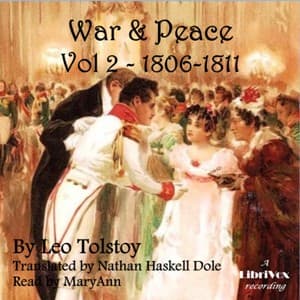
This is Volume 2 of the Dole translation, which means we're deep into it — past the introductions and the salon small talk of Volume 1, past Tolstoy warming up. Here, he's running. The Battle of Borodino. Napoleon in Moscow. Pierre's spiritual wandering. Natasha's collapse and reconstruction. Prince Andrei's slow, devastating arc toward something I won't spoil but that had me standing still on the path near Montrose Harbor, earbuds in, just... not moving. Denise had to circle back for me.
Tolstoy at the Speed of Walking
Let me be honest about something: I've taught excerpts of War and Peace for fifteen years. Assigned chapters. Talked about Tolstoy's theory of history in class with the confident authority of someone who had, embarrassingly, never actually finished the whole novel. I'd read maybe sixty percent across various attempts. The Dole translation specifically — which is the oldest major English version, dating back to the 1880s — has a formality to it that I used to find off-putting on the page. Stiff. Almost Victorian in its constructions.
But here's where audiobook changes everything: that formality becomes gravity in spoken form. When MaryAnn Spiegel reads Dole's translation aloud, the slightly archaic phrasing stops feeling like a barrier and starts feeling like register. Like you're hearing a story told by someone who understands that these events — war, love, death, the absurd comedy of Russian aristocratic life — deserve a certain weight in the telling. The prose deserves to be savored, and Spiegel seems to agree. Her pacing is unhurried. Steady. She trusts the sentences.
Now, is the Dole translation the best War and Peace available? Scholars would point you to Pevear and Volokhonsky, or maybe the Briggs. The Dole can be clunky where those are fluid. But there's something about its old-fashioned cadence that works for audio — it sounds like literature being read aloud in a drawing room, which is, well, exactly how Tolstoy's original audience would have experienced it. One listener called it "fireside reading as a family pastime," and that's exactly right.
MaryAnn Spiegel and the Virtue of Restraint
Spiegel's narration is what I'd call principled minimalism. She doesn't do voices. She doesn't attempt a Russian accent for Kutuzov or a French one for Napoleon's scattered dialogue. She reads. Consistently, clearly, at a pace that lets Tolstoy's own rhythms do the work.
And honestly? For this book? That's the right call. War and Peace has — I stopped counting — something like five hundred named characters. Any narrator who tried to give each one a distinct voice would either go insane or sound insane. Spiegel's approach is ungimmicky in the best sense. You always know who's speaking because Tolstoy tells you, and she trusts that.
There are pronunciation stumbles. A handful of Russian names get slightly bent. (I noticed it with patronymics especially — she'll nail "Bolkonsky" perfectly and then wobble on "Drubetskoy" in a way that made me smile rather than wince.) If you're a stickler, it might bother you. For me, it felt human. Like a very smart person reading a very long book with care and occasional imperfection. Which is all any of us can do with Tolstoy.
The narrator understands that pause is punctuation — she gives the heavy moments room to land without overselling them. During Prince Andrei's arc in particular, there's a restraint in her delivery that actually made the emotional weight hit harder than a more theatrical reading might have.
Who Needs This and Who Doesn't
If you want a polished, full-production War and Peace with distinct character voices and accent work — this isn't it. Look elsewhere. If you've bounced off the novel three times (like I did) and want someone to simply, patiently, competently read you one of the greatest novels ever written while you walk along a lake or grade a stack of mediocre essays on The Great Gatsby — this is your version. It's free, it's LibriVox, and it's better than it has any right to be.
My students would hate this. I love it.
But I'll be honest: sixteen hours is only Volume 2. You need all four volumes. That's a commitment. If you loved the patience of Middlemarch on audio, this is its spiritual successor — Russian, bloodier, with more characters than a Dickens novel and a theory of history that still makes historians angry. On a completely different scale — shorter, sharper, more bourbon than borscht — I found a similar kind of sprawling family drama done well in Bourbon Kings, though Tolstoy would have given those Bradfords another four hundred pages and a theory of American capitalism.
The Margin Note I'd Leave for My Students
This reminds me of what Hemingway said — that all American literature comes from Huckleberry Finn. Well, all Russian literature comes from this. And you don't have to read it. You can listen to it, on a lakefront, in October, while your wife walks ahead and pretends she doesn't notice you crying near Montrose Harbor.
Worth pausing the faculty meeting for. Worth pausing everything for.