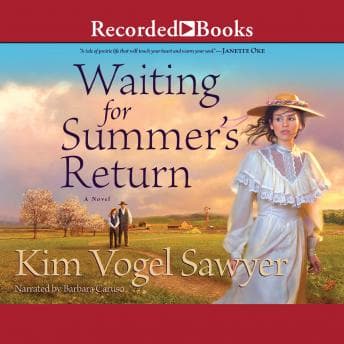

I was grading papers at 11 PM—the usual stack of half-hearted essays about The Great Gatsby—when Summer Steadman lost her fourth child. I had to put down my red pen. Sometimes a book finds you at exactly the wrong moment, and you realize it was actually the right one.
Kim Vogel Sawyer's debut novel doesn't waste time with pleasantries. We open in 1894 Kansas with a woman who has buried her husband and all four of her children. She's refusing to eat. She's bitter at God. And honestly? I didn't blame her. This isn't the sanitized grief we often get in Christian fiction—it's the kind that makes you stop believing in anything at all.
When Grief Has a German Accent
Barbara Caruso's narration took me a chapter or two to settle into. The opening felt slightly rough, like she was still finding Summer's voice. But then Peter Ollenbuger enters—this widower who offers Summer food and shelter in exchange for tutoring his son—and Caruso's German accent work becomes genuinely impressive. The way she shifts between Summer's American despair and Peter's measured, accented faith creates this immediate class and culture divide that the text alone couldn't accomplish.
Here's what I appreciated: Caruso doesn't perform German as caricature. Peter sounds like a man who learned English as a second language and carries his heritage in his vowels. His patience, his careful word choices—you can hear the deliberation. My students would call this "boring." I call it character work.
The emotional delivery is where Caruso earns her keep. Listeners apparently laughed and cried their way through this, and I understand why. When Summer finally breaks—when faith starts to crack through that wall of bitterness—Caruso doesn't oversell it. She lets the silence do the work. (This reminds me of what Hemingway said about the dignity of movement of an iceberg. Most of the emotion is beneath the surface.)
Faith Without the Sermon
I've taught enough literature to recognize when an author is preaching at me versus when they're showing me something true. Sawyer manages the latter. The Christian themes are present—unavoidably so—but they're woven into character rather than delivered in monologue. Peter's faith isn't presented as the answer to Summer's grief. It's presented as his answer, and Summer has to find her own way there.
The prose deserves to be savored. Sawyer writes with the kind of restraint that suggests she trusts her readers. No melodrama. No manipulation. Just two broken people in Kansas trying to figure out how to live again.
That said, the ending wraps up faster than I'd like. After nearly twelve hours of careful, slow-burn emotional work, the resolution feels slightly rushed. Not enough to ruin anything, but enough that I noticed.
Who Should Listen (And Who Should Skip)
If you're looking for historical fiction that takes faith seriously without becoming saccharine, this is your book. If you loved Janette Oke's prairie romances but wished they had more emotional complexity, Sawyer is the spiritual successor. Though if you're after something with more edge and political weight, Things That Matter offers that kind of intellectual heft. If you need something for background listening while working—several listeners mentioned this—it holds up surprisingly well.
But I'll be honest: if you find earnest faith narratives difficult, or if you're sensitive to child death as a plot device (understandably so), this might not be your listen. Some folks found Caruso's voice irritating—I didn't, but voice preference is personal. Maybe sample the first chapter before committing.
Worth Pausing the Faculty Meeting For
At nearly twelve hours, this is a commitment. I listened across two weeks of late-night grading sessions, lakefront walks with Denise, and one particularly long faculty meeting about next year's budget. (Principal Martinez, I was definitely paying attention. I wasn't.)
What stayed with me wasn't the romance—though it's there, quiet and earned. It was Summer's journey from refusing to eat to refusing to give up. Caruso's narration grows stronger as Summer does, which might be intentional or might be happy accident. Either way, it works.
The author's Christian emphasis never becomes trite or sappy—a genuine achievement in this genre. And Caruso's performance, once you get past that slightly uneven opening, becomes something worth returning to. Apparently the sequel has a different narrator, and listeners say Caruso's version is better. I believe it.
My students would hate this. Too slow. Too earnest. Too much about feelings they haven't earned yet.
I loved it.