
"The way to achieve true political happiness is to be in the right political minority."
That line hit me somewhere around hour two, and I had to pause the audiobook to write it down. I was grading papers at the time—AP English essays on The Great Gatsby—and suddenly Krauthammer's voice was making more sense than half of what my students were saying about the American Dream.
Look, I'll be honest. I came to this collection as someone who doesn't share most of Krauthammer's political positions. That same quality of making you reconsider your assumptions shows up in I Know Why the Caged Bird Sings, though Angelou's memoir comes from a completely different political and personal landscape. But here's the thing about great essayists—and I say this as someone who's spent two decades trying to teach kids why Orwell and Didion matter—they make you think even when you disagree. Especially when you disagree. That's the whole point.
The Voice We Lost
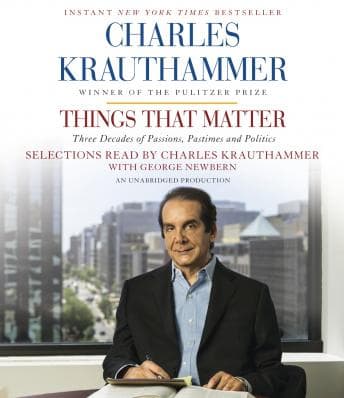
Krauthammer narrates the first half of this audiobook himself, and there's something almost unbearably intimate about hearing a writer read his own words. His voice is measured, deliberate. He doesn't rush. He trusts the prose to do the work. As someone who listens at 1.0x because the author chose those words, I appreciated that he clearly felt the same way about his own sentences.
The autobiographical introduction alone is worth the listen. Here's a man who trained as a psychiatrist, became paralyzed in a diving accident during his first year of medical school, and still finished his degree. Then pivoted to speechwriting, then to journalism, then to becoming—whether you love him or hate him—one of the most influential political voices of his generation. The way he tells it, without self-pity, without melodrama, is a lesson in restraint. My students would hate it. They want everything spelled out emotionally. I loved it.
And then, somewhere around the midpoint, the narrator changes.
When the Voice Shifts
George Newbern takes over for the second half, and—okay, I need to be honest here. The transition is jarring. One listener described it as "losing Charles a second time," and that's not hyperbole. You've been inside this man's head, hearing his actual voice shape his actual thoughts, and then suddenly you're not.
Newbern is a fine narrator. Clear, professional, intelligent. He reads Krauthammer's words with respect. But it's not the same. It can't be. This is the fundamental problem with essay collections in audio format—when the author's voice IS the style, a replacement can only approximate.
I found myself adjusting after about twenty minutes. Once I stopped expecting Krauthammer, I could appreciate what Newbern brought to the later essays. But I'd be lying if I said the listening experience didn't lose something.
What the Essays Actually Offer
Here's where I put on my teacher hat for a second. This collection spans thirty years, which means you're getting a time capsule of American political and cultural life from the 1980s through the 2010s. Some essays feel eerily prescient. Others feel dated in ways that are themselves instructive. (That's history, kids. That's why we study it.)
The range surprised me. Yes, there's plenty of political commentary—foreign policy, domestic debates, the usual suspects. But there are also essays on chess, on baseball, on border collies, on Halley's Comet. Krauthammer on Woody Allen. Krauthammer on Churchill. The man could write about almost anything and make it feel consequential.
His bioethics essays are particularly worth your time, regardless of where you fall politically. He brings a physician's training and a philosopher's rigor to questions about cloning, stem cells, the boundaries of medical intervention. Even when I disagreed—and I often did—I couldn't dismiss the arguments. He'd anticipated my objections before I could form them.
The Listening Experience
I listened to most of this during my morning walks along the lakefront with Denise. She'd occasionally ask why I was muttering to myself. "Arguing with a dead man," I'd say. She's used to it by now.
The production quality is clean. No weird audio artifacts, no distracting background noise. At twelve hours, it's a commitment, but essay collections have a natural advantage here—you can dip in and out, take breaks, come back. It's not a novel demanding continuous attention.
Would I recommend this to my students? The ones who actually want to understand how political argument works at its best, yes. The ones who just want to be told what to think, no. Krauthammer demands engagement. He assumes you're smart enough to follow the reasoning and honest enough to admit when he's made a point.
Who Should Listen (And Who Should Skip)
If you're interested in American political history from someone who was actually in the room—or at least in the columns that shaped the conversations in the room—this is essential. If you appreciate essay writing as a craft, as a form of thinking-on-the-page, Krauthammer is worth studying even if you'd never vote for anyone he endorsed.
If you need a single consistent narrator, maybe read the print version instead. The audio transition is a real issue, not a minor quibble.
But if you can push through that shift, there's something valuable here. A record of one mind grappling with three decades of American life. Flawed, brilliant, infuriating, illuminating. Worth pausing the faculty meeting for. (Sorry, Principal Martinez.)









