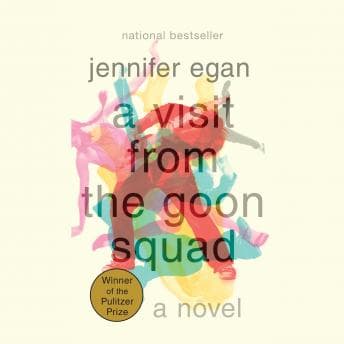

Everyone told me this was a literary masterpiece that would change how I think about time and music and identity. Pulitzer Prize winner. Great American Novel status. And I'm sitting in my driveway at 7:45 AM after a twelve-hour shift thinking... okay, but did I enjoy it?
The answer is complicated. Which I think is actually the point.
Time Is the Goon and It Will Get You Too
So here's the thing about A Visit from the Goon Squad - it's not really a novel. It's thirteen interconnected stories that jump around in time, following a constellation of characters orbiting Bennie Salazar, a former punk rocker turned music executive, and Sasha, his kleptomaniac assistant. You get Sasha stealing a wallet from a woman's purse in a hotel bathroom. You get Bennie sprinkling gold flakes into his coffee because he's desperate to feel something again. You get a PR woman in a dictator's entourage. You get the future, where babies control music consumption and language has been compressed into texts.
Each chapter shifts perspective, shifts decade, shifts tone. It's disorienting in the best and worst ways. I kept losing my footing - who is this person? Wait, is this the same Scotty from three chapters ago? - and honestly, audio makes that harder than print probably does. There's no flipping back to check. You just have to trust that Egan knows where she's going.
She does. Mostly.
The Chapter That Made Me Almost Rear-End Someone
The Sasha chapter - the first one, where she's on a date and simultaneously processing her compulsion to steal - is stunning in audio. Roxana Ortega nails the split consciousness of it, the way Sasha is performing normalcy while her hands are doing something else entirely. The self-awareness mixed with total inability to stop. I've seen patients like that. People who can describe exactly what's destroying them while actively choosing it again. That particular kind of lucid self-destruction showed up in a different way in Dangerous Secrets, where the emotional damage is just as visible to everyone except the person living it.
But then there's the PowerPoint chapter. You know the one - Egan wrote an entire chapter as a PowerPoint presentation. In the printed book, apparently it's this visual marvel with charts and diagrams about pauses in songs. In audio? Ortega basically narrates what would be on the slides. "Slide: Great Rock and Roll Pauses." It's... fine? But you can feel the gap between what this was meant to be and what audio can deliver. It's like watching someone describe a painting instead of showing you the painting.
Ortega does her best work in the quieter, more devastating chapters. The one about the music journalist who interviews Bennie's old bandmate Scotty years later, and you realize how much wreckage a single life can accumulate - she reads that with this restrained sadness that hit me right in the sternum. Carlos asked why I was crying in the car. I blamed allergies. In June. In Phoenix. He didn't buy it.
Ortega Carries a Heavy Load (Mostly Successfully)
Single narrator for a book with this many characters spanning this many decades is ambitious. Ortega handles the women better than the men, which - fair enough, that's a lot to ask. Her Sasha is distinct from her Rhea is distinct from her Dolly. But some of the male characters blur together, especially the aging rockers, who all start sounding like variations on the same regretful baritone.
Her pacing is good when the chapters are propulsive but drags during the more introspective passages. I caught myself zoning out during the Africa chapter - and look, I was post-shift tired, but I've listened to entire thrillers at 4 AM without losing focus. The energy just dips in places.
The bonus interview with Egan is worth sticking around for, though. She talks about how the book's structure mirrors the way music works - themes that recur, variations on a melody - and suddenly the whole thing clicked in a way it hadn't while I was just listening to the story.
Who This Is (and Isn't) For
If you need plot, if you need a through-line you can follow from A to B - this will frustrate you. If you want to feel the specific ache of watching people you knew at twenty become strangers at forty-five, if you've ever heard a song from high school and felt your whole body remember who you used to be - this book will gut you.
My mom would love this (she still thinks I should've been a doctor), actually. It's about ambition and compromise and the gap between who you planned to be and who you became. Every Filipino parent understands that math.
But I'd recommend the print version first, honestly. The PowerPoint chapter alone justifies holding the physical book. Come to audio for the re-read, when you already know the characters and just want Ortega's voice connecting the threads.
Night Shift Prescription
Not night shift approved - too fractured for tired brains. This needs your attention. Save it for a day off, or a long drive when you're actually awake. It rewards patience, but it demands it too. The goon squad is time itself, and this book makes you feel every minute of it - the ones you wasted, the ones you'll never get back, the ones happening right now while you're not paying attention.
I sat in my driveway for ten minutes after it ended, engine off, just thinking about the people I've lost track of. Then I went inside and made pancakes for my kids. Time's a goon, but breakfast is breakfast.









