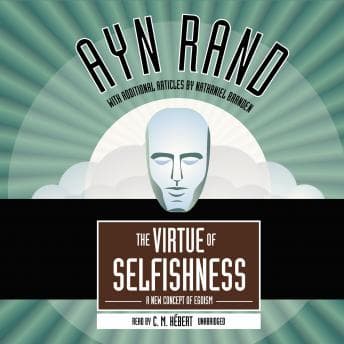

Ayn Rand would have hated me.
I'm a researcher who spends her days studying why humans are fundamentally social creatures, how our identities are shaped by connection and community. And here I am, chopping onions for a curry I'll eat alone (by choice, thank you very much), listening to six hours of philosophical essays arguing that rational self-interest is the highest moral good.
The irony isn't lost on me. My therapist would have thoughts about this character—meaning me, choosing to engage with a philosophy that fundamentally contradicts my professional worldview.
The Psychology of Provocation
Here's what I'll give Rand: she understood something essential about human motivation. The protagonist of her philosophy—the rational egoist—exhibits classic reaction formation. She's not just arguing for self-interest; she's constructing an entire ethical framework as a defense mechanism against collectivist trauma. Born in Soviet Russia, watched her family's property seized, fled to America. The research actually shows that people who've experienced forced collectivism often swing hard toward individualism.
A fascinating case study in how personal history shapes philosophical conviction.
But—and this is where my training kicks in—Rand makes a fundamental error that any first-year psych student would catch. She conflates rational self-interest with psychological health. She assumes humans can neatly separate their interests from others' through pure reason. Psychologically, this doesn't track. We're wired for interdependence. Mirror neurons exist. Attachment theory isn't optional.
The nineteen essays here range from genuinely provocative ("The Ethics of Emergencies" made me pause my cooking and just stand there thinking) to frustratingly reductive. Nathaniel Branden's contributions on self-esteem are actually more nuanced than Rand's—probably because he's a psychologist, not a novelist playing philosopher.
C. M. Hébert's Cold Conviction
The narration is... interesting. And I mean that in the clinical sense.
Hébert reads with what I can only describe as ideological certainty. Her voice is efficient, almost sterile—which some listeners apparently hate. One reviewer said she sounds like "we are listening to something evil." That made me laugh, honestly. Because here's the thing: the cold, confident delivery actually works for this material. Rand wasn't warm and fuzzy. Her philosophy isn't meant to comfort you. It's meant to challenge you.
But I found myself asking: why does this narration feel so exhausting after hour three? It's the lack of emotional variation. When you're listening to philosophy—especially contentious philosophy—you need some vocal texture to stay engaged. Hébert's Earphones Award-winning performance is technically proficient, but it's like eating plain rice for six hours. Nutritionally complete. Flavorless.
I had to take breaks. Made my curry. Went for a jog. Came back.
Who Should Argue With Their Kitchen Appliances
Let me be direct: if you're already a Rand devotee, you've probably read this. The audiobook is a decent way to revisit it. If you're a philosophy student or someone curious about Objectivism, this is the most concentrated dose you'll find—more accessible than Atlas Shrugged, more systematic than The Fountainhead.
But if you're looking for a balanced examination of ethical egoism? This isn't it. Rand doesn't engage seriously with counterarguments. She dismisses altruism as "self-sacrifice" without acknowledging that helping others can be genuinely fulfilling (again—mirror neurons, Ayn). Rules Do Not Apply: A Memoir wrestles with similar questions about self-interest versus obligation, though Ariel Levy's approach is far more psychologically honest about the messiness of human motivation.
Skip if: you need your philosophy warm, or you want genuine intellectual debate rather than manifesto.
Listen if: you want to understand a worldview that's shaped American libertarianism, or you're writing a paper on twentieth-century ethical philosophy, or—like me—you believe in understanding positions you disagree with.
Diagnosis: Productive Irritation
I finished this while washing dishes, the last essay playing as I dried my hands. Did Rand convince me? No. Did she make me think harder about my own assumptions regarding selfishness and morality? Reluctantly, yes.
That's worth something.
The audiobook is a serviceable delivery mechanism for challenging ideas. Hébert's cold precision will work for some and grate on others. At just over six hours, it's a reasonable commitment for what amounts to a philosophical education—even if that education is in a philosophy you'll ultimately reject.
I found myself taking notes. Arguing back. Getting annoyed. That's more than most audiobooks accomplish.
My mother would ask why I'm listening to books that make me argue with no one in the kitchen. "Because, Maa, that's exactly how this works."