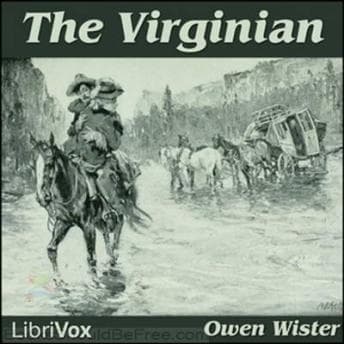

Everyone tells you The Virginian is the first Western novel. They say it the way my students say Shakespeare invented English — with that reverent, uncritical tone that should make you immediately suspicious. So I went in expecting a dusty museum piece, a historical curiosity you appreciate more than enjoy. And for about the first two hours, walking the lakefront with Denise on a Saturday morning cold enough to make my ears burn, I thought I was right.
Then the Virginian opened his mouth, and I shut mine.
The Cowboy Who Reads Too Much
Here's what nobody prepares you for: the Virginian is an intellectual. Not in the bookish, grad-school way — in the dangerous way. He quotes Shakespeare to win arguments. He outmaneuvers a preacher in theological debate. He tells tall tales with the structural precision of a short story writer, and Owen Wister clearly wants you to understand that this man's mind is his real weapon, not his six-shooter. The famous "When you call me that, smile" line? That's not a tough-guy moment. It's a man calmly establishing the rules of discourse. With a gun on the table, sure. But discourse.
This is what makes the book still worth your time 120 years later — and also what makes it deeply uncomfortable. Because Wister is building an argument for natural aristocracy, and he's building it well. The Virginian rises not because of birth or education but because he's simply better than the men around him. Smarter, calmer, more capable. And Wister uses that to justify some genuinely troubling things, including the lynching of cattle rustlers — one of whom is the Virginian's closest friend.
Let's talk about what the author is really saying. Wister wasn't writing escapism. He was writing political philosophy dressed in chaps. The novel takes the large ranchers' side of the Johnson County War and presents vigilante hanging as rational frontier governance. The Virginian doesn't enjoy it. He agonizes. But he does it. And Wister wants you to nod along because by then you trust this man's judgment completely. That's sophisticated rhetoric, and it's worth examining rather than simply accepting or rejecting.
Denise Michelle Harris and the Problem of Pace
Now — the narration. I have to be honest: I don't have a ton of specific detail on Harris's performance to dissect, and I won't pretend otherwise. What I can tell you is this is a 14-and-a-half-hour listen, single narrator, covering a novel with extensive dialect writing, long philosophical conversations, and some genuinely funny set pieces (the frog-swapping scene and the babies-swapping scene are comedy gold that my students would actually laugh at, if I could ever get them to read anything published before 2015).
The challenge for any narrator here is enormous. Wister wrote the Virginian's dialogue in heavy Southern vernacular — dropped g's, regional grammar, phonetic spelling — while his narration and the schoolmarm Molly Wood's dialogue are formal, almost Jamesian. You're essentially performing two different registers of English for 14 hours. Harris takes a steady, measured approach. At 1.0x — because the author chose those words — the pacing suits the novel's long, ruminative middle section, where the Virginian and Molly circle each other in what might be the slowest courtship in American literature. But during the cattle drive sequences and the final showdown, I found myself wishing for a little more electricity in the delivery. The prose deserves to be savored, yes, but some passages need heat.
Why This Book Still Picks a Fight
I finished the last chapter grading sophomore essays on To Kill a Mockingbird at 11 PM, and the juxtaposition hit me hard. Both novels ask the same question: Who gets to decide justice when institutions fail? It's the same question Golding wrestles with in Lord of the Flies, though he strips away the mythology and gives us children instead of cowboys. Wister's answer is profoundly different from Harper Lee's, and profoundly more dangerous, and I think that's exactly why you should listen to it. Not because it's comfortable. Because it's the origin point of a mythology America still hasn't reckoned with — the idea that the right man with a gun IS the law.
My students would hate this. I love it. Not because I agree with Wister's politics — I don't, and neither should you accept them uncritically. But because understanding where the cowboy myth comes from is the only way to understand why it still has such a grip on us. This is why we still read the classics. Not because they're right. Because they're foundational.
Who Saddles Up and Who Rides Past
If you loved Lonesome Dove, this is its spiritual ancestor — leaner, more ideological, less sprawling but more focused. If you want action-packed Western adventure, adjust your expectations: this is a novel of ideas that happens to take place on a ranch. If you're sensitive to sympathetic portrayals of lynching, the content warning is real and you should take it seriously. Wister isn't ironic about it. He means it.
Worth your time if you want to understand the DNA of every Western that came after. Just don't mistake understanding for endorsement.