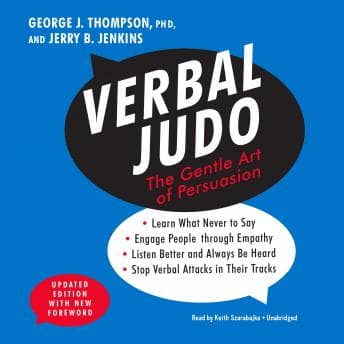

Quick Verdict: Worth your commute. This is basically a debugging manual for human communication, and the ROI on this audiobook is surprisingly high.
Okay, so I'll admit I was skeptical. Another self-help book that could've been a blog post? I've been burned before. But three commutes in, I was genuinely taking mental notes. That same practical wisdom showed up in Surrender Experiment, though Michael Singer takes a completely different approach—letting go instead of strategizing. George Thompson was a cop and a martial arts instructor who figured out that words work better than force in 99% of confrontations. The core concept—verbal judo, redirecting someone's aggression instead of meeting it head-on—is so obvious once you hear it that you wonder why nobody taught you this in school.
The Framework That Actually Sticks
Here's the thing about most communication books: they give you vague advice like "be empathetic" and call it a day. Thompson actually gives you scripts. Specific phrases. Decision trees for when someone's in your face. His five universal truths (people want respect, want to be asked not told, want to know why, prefer options to threats, and want second chances) sound basic, but he shows you exactly how to apply them when your manager is being unreasonable or when you're trying to get a teenager to do literally anything.
The examples are mostly from law enforcement, which might seem niche, but honestly? Dealing with an angry person at a traffic stop isn't that different from dealing with an angry stakeholder in a meeting. The stakes are different, sure, but the psychology is the same. I found myself thinking about how many production incidents could've gone smoother if I'd known this stuff earlier. (Not that I'm naming names.)
Keith Szarabajka Nails the Delivery
I finished this in about 3 commutes at 1.5x, and Keith Szarabajka's voice is perfect for this material. He's got this slightly rough, warm tone that makes you feel like a seasoned mentor is walking you through scenarios. The stories Thompson tells—and there are a lot of them—land because Szarabajka knows when to lean into the drama and when to pull back for the teaching moments.
What I appreciated is that he doesn't oversell it. Some self-help narrators sound like they're trying to convince you to join a cult. Szarabajka sounds like a guy who's seen some stuff and is just telling you what worked. The pacing is solid—no sections where I zoned out, which is saying something for a 6-hour instructional book.
Where It Gets Real
Look, I'm not going to pretend this book changed my life. But it did change how I approach certain conversations. The concept of "tactical empathy"—using phrases like "I understand, and..." instead of "I understand, but..."—is such a small shift that has a weirdly big impact. I tried it on Kevin when we were arguing about whose turn it was to deal with the Caltrain parking situation. It worked. He was suspicious, but it worked.
The book does have some dated moments. Thompson passed away in 2011, and while Jerry Jenkins updated this edition, some of the examples feel very 90s-cop-show. And yeah, there's a lot of law enforcement perspective that won't apply to everyone. But the underlying principles? Those are timeless. People are people, whether you're dealing with a suspect or a senior engineer who doesn't want to refactor their code.
One thing that stuck with me: Thompson talks about how most people default to "react" mode when confronted, but the goal is to "respond" instead. Reacting is emotional and immediate. Responding is intentional. It's basically the communication equivalent of not pushing to production on a Friday—take a beat, think it through, then act.
Who's This For?
This is an easy listen that doesn't require your full attention—ideal for commutes or workouts. You'll catch the key concepts even if you're half-asleep at 6 AM surrounded by other zombies. Skip it if you want deep research or academic rigor; this is field-tested wisdom, not peer-reviewed studies. But if you deal with on-call escalations, angry customers, or just humans who occasionally frustrate you? The scripts alone are worth the 6 hours.
Ship It
Would I recommend this to my team? Actually, yeah. And honestly, if more people in tech knew this stuff, we'd all have fewer Slack threads that end in passive-aggressive emoji reactions. The science isn't research-heavy, but the practical wisdom holds up—Thompson field-tested these techniques for decades, and it shows. Not every self-help book earns its length, but this one does.