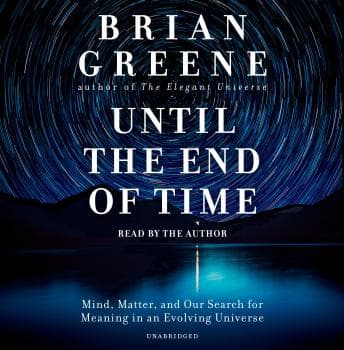

Look, I have a complaint. I was halfway through making my mother's rajma recipe — the one that takes two hours and requires you to babysit the pressure cooker like it's a toddler near a staircase — when Brian Greene casually informed me that every particle of my being, every memory I hold, every relationship I cherish, will eventually dissolve into a cold, featureless void of maximal entropy. And I just stood there, wooden spoon in hand, staring at the steam rising from the pot, thinking: well, that puts my publication anxiety in perspective.
This book did something to me that physics books rarely do. It made me feel psychologically examined.
A Physicist Who Accidentally Wrote a Psychology Book
Here's what caught me off guard. Greene structures Until the End of Time as a cosmological journey — Big Bang to heat death, particles to planets, the whole arc — but what he's really doing is building a case study of the human mind's refusal to accept its own insignificance. And as someone who studies why humans construct narratives to make sense of themselves, I found myself asking: why does Greene keep circling back to consciousness, to storytelling, to our desperate need for meaning?
Because that's what this book is actually about. Not physics. Not really. It's about why a species that emerged from random molecular processes on an unremarkable planet developed religion, art, mathematics, and the stubborn conviction that it all matters. Greene spends substantial time on entropy — the second law of thermodynamics as this quiet, relentless engine driving everything forward — but he treats it less like a physics lecture and more like an existential reckoning. The protagonist here exhibits classic terror management behavior. We build monuments, write sympheses, develop string theory, all because we cannot sit quietly with the knowledge that we are temporary.
My therapist would have thoughts about this book. Specifically about how Greene manages to be both utterly clear-eyed about cosmic futility and somehow... warm about it? Gentle, even. There's a passage where he discusses how the same evolutionary pressures that gave us anxiety and existential dread also gave us Beethoven and the Hubble telescope. That's not a throwaway observation. That's a framework for understanding human motivation that I genuinely wish more psychologists would engage with. Blink gestures at something similar — the idea that our unconscious machinery shapes behavior in ways we barely understand — but Greene goes so much deeper into the evolutionary why behind it all.
Greene Reading Greene: The Rare Author-Narration That Works
I'm picky about author-narrated audiobooks. Most scientists read their own work like they're presenting at a conference — monotone, rushing through the good parts, lingering on methodology nobody asked about. Greene is different. His voice has this quality I can only describe as persuasive calm. He sounds like someone explaining something enormous to you over tea, someone who genuinely believes you can follow along and wants you to. There's no condescension, no dumbing-down, just this steady, caring cadence that makes fourteen-and-a-half hours feel... manageable.
That said — and this is important — this is a focus listen. I tried taking it on my morning jog through Cambridge once. Bad idea. Greene is building layered arguments that connect thermodynamics to consciousness to free will to the nature of creativity, and if you zone out for three minutes because a cyclist almost killed you on Mass Ave, you've lost the thread. I ended up rewinding constantly. The kitchen worked much better. Something about the meditative rhythm of chopping onions pairs well with contemplating the heat death of the universe.
At nearly fifteen hours, this is a commitment. But Greene earns the runtime. He's not padding — he's building. Each section feeds the next. The early chapters on particle physics establish the rules of the game, the middle chapters on evolution and consciousness raise the stakes, and the final stretch on meaning, religion, and creative expression delivers the psychological payoff.
Who This Is Really For (And Who Should Run)
If you want a straight physics primer, this isn't it. Greene assumes you're here for the why, not just the how. If you're someone who lies awake wondering whether your choices matter in a deterministic universe — congratulations, you're his target audience, and also maybe see a therapist (I say this with love and from experience). If you need action or plot twists or anything resembling narrative urgency, you will be bored. This is a slow, steady, gorgeous descent into the biggest questions humans have ever asked.
The research actually shows that people who engage with existential themes through structured frameworks — religion, philosophy, science — report less anxiety than those who avoid the topic entirely. Greene's book functions almost like a secular framework for sitting with mortality. Which is not what I expected from a string theorist, but here we are.
Psychologically, what makes this book compelling is that Greene doesn't flinch. He doesn't offer false comfort. He doesn't pretend the universe cares about us. But he argues — convincingly, patiently, with that impossibly gentle voice — that our caring about the universe is itself extraordinary. That consciousness generating meaning from meaninglessness might be the most remarkable thing entropy ever accidentally produced.
My Case Notes Say: Listen With Intention
I finished this at 1 AM, standing in my kitchen, the rajma long since eaten and the dishes unwashed. And I just sat with it for a while. Not sad exactly. More like... recalibrated. This is a fascinating case study in how a physicist processes the same existential questions that drive my entire field, and arrives at something that feels honest without being nihilistic. It won't change your life — I'm suspicious of any book that claims to — but it might quietly shift how you think about the fact that you have one.