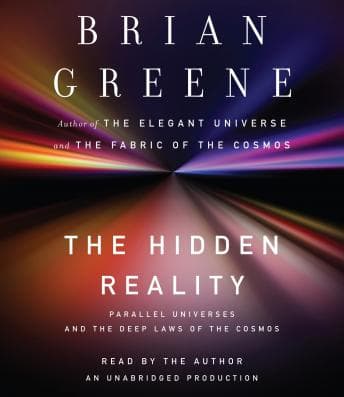

Everyone told me this was the "accessible" physics book. The one where Brian Greene makes multiverse theory feel like a conversation over coffee. And yeah, sure, in the same way that a graduate seminar led by a really charming professor feels like a conversation over coffee - you're nodding along, you're following the analogies, and then suddenly you realize you've been staring at the same Caltrain window for twenty minutes trying to figure out if the Quilted Multiverse means there's a version of you who actually understood the Quilted Multiverse on the first pass.
I want to be upfront: this is NOT a 6AM commute book. I learned that the hard way.
Your Brain Needs to Be Online for This One
I started this during my morning commute and made it about 40 minutes before I realized I'd retained absolutely nothing after Greene's explanation of the Inflationary Multiverse branching mechanism. Not because it was bad - it's genuinely well-constructed - but because this book demands the kind of focused attention that a packed train full of people coughing and someone's AirPods leaking a podcast about crypto just cannot support.
So I switched strategies. Finished most of it during a weekend where Kevin was at a climbing gym and I had the apartment to myself. Made coffee, sat on the couch, and actually listened. Night and day difference. The nine distinct multiverse proposals Greene walks through - Quilted, Inflationary, Brane, Cyclic, Landscape, Quantum, Holographic, Simulated, Ultimate - they build on each other. Miss the setup for one and the next feels like joining a conversation midway through.
The Simulated Multiverse chapter genuinely kept me up. Not in a fun sci-fi way but in a "wait, is the probability argument actually sound?" way. Greene lays out the simulation hypothesis with enough mathematical scaffolding that it stops feeling like a Reddit thread and starts feeling like... a real problem. I ended up going down a rabbit hole on the simulation argument at 1AM, which is exactly what happened the last time I read one of his books, so apparently some patterns are multiversally consistent. Honestly the only other audiobook that's sent me spiraling into late-night research the same way was Inside of a Dog - completely different subject matter, but Alexandra Horowitz has the same gift for making you realize you've been casually wrong about something fundamental your entire life.
Greene Narrating Greene: A Feature and a Bug
Here's the thing about author-narrated science books - you get the emphasis exactly where the author intended it. Greene knows which analogies he's most proud of, and you can hear it. When he's building up to his comparison of cosmic inflation to Swiss cheese (where the cheese is the inflating space and the holes are pocket universes that stop inflating), there's this specific cadence shift. He slows down, gets almost conspiratorial. It works.
But 13 hours and 49 minutes is a LOT of one voice, especially one that has a slightly professorial rhythm that can start to feel... metronomic? By hour 8, I found myself bumping to 1.5x just to break the pattern. At 1.5x Greene sounds like an excited professor rather than a measured one, which honestly improved the experience. I wouldn't go higher though - at 1.75x the math-adjacent sections become word soup.
He's not Ray Porter. (Nobody is Ray Porter.) But he's clear, he genuinely understands what he's saying at a level no hired narrator could match, and his analogies - even the imperfect ones - land better coming from him because you can tell he's been workshopping them in lecture halls for years.
The String Theory Elephant in the Room
Look, Greene is a string theorist. He's going to advocate for string theory. If you go in expecting a neutral survey of multiverse concepts, you'll be frustrated by how many of the nine proposals conveniently circle back to string landscape territory. It's like asking a distributed systems engineer (hi) to explain database architectures and being surprised when they keep bringing up eventual consistency - it's not dishonest, it's just their lens.
That said, he's reasonably transparent about what's established physics, what's speculative, and what's basically mathematical philosophy. The gradations between "we have evidence for this" and "this is theoretically possible" and "this follows if you accept these axioms" are pretty clearly marked. I appreciated that. The science actually holds up - or at least, Greene is honest about where it stops being science and starts being informed speculation.
What bugged me more was the pacing. Some multiverse models get deep, loving treatment (Inflationary, Quantum) while others feel rushed. The Holographic Multiverse chapter felt like it deserved twice the runtime. And occasionally Greene spends so long building an analogy that by the time he applies it, you've forgotten what question he was answering.
Perfect For: Weekend Deep Dives. Skip For: Drowsy Commutes.
If you've read The Elegant Universe or The Fabric of the Cosmos, this is the logical next step - but it's also the hardest of the three. If this is your first Greene book, honestly, start with Fabric of the Cosmos instead. This one assumes a comfort level with quantum mechanics and general relativity that the earlier books build more carefully.
The ROI on this audiobook is high IF you give it the right conditions. Focused listening sessions, willingness to rewind, maybe a notepad nearby. It's basically a graduate lecture series but for curious engineers who want to understand why physicists keep multiplying universes. If you want something you can absorb while half-asleep on public transit, this ain't it.
Commit Your Attention or Don't Bother
I finished this in roughly 9 hours of actual listening time (thank you, 1.5x) spread across a weekend and a few lunch breaks. It expanded how I think about what "everything" means, which is a weird thing to say about an audiobook but here we are. Not Greene's most engaging work, not his most accessible, but possibly his most ambitious. Just don't try it on the 6:12 Caltrain. Trust me on this.





![Steve Jobs [unabridged audiobook] audiobook cover](/_next/image?url=https%3A%2F%2Fcovers.audiobooks.com%2Fimages%2Fcovers%2Ffull%2F9788499923406.jpg&w=1920&q=75)