
"Teens today are forty percent less empathetic than they were thirty years ago."
That stat hit me at about the fifteen-minute mark while I was cleaning up the kitchen after dinner. Jenny was upstairs putting our daughter to bed, and I just stood there holding a sponge, doing math in my head. Forty percent. If a company's core competency dropped forty percent in three decades, we'd call it a turnaround situation. We'd bring in consultants. We'd panic.
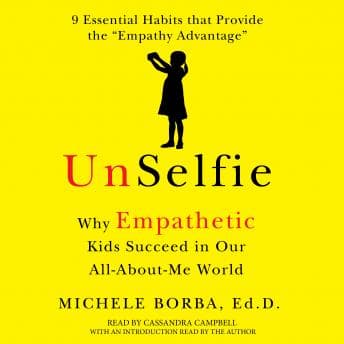
Dr. Michele Borba basically wrote the turnaround playbook. And honestly? It's better than most business turnaround playbooks I've read.
The Framework That Actually Earned Its Nine Steps
Look, I'm allergic to numbered frameworks. "Seven habits," "four agreements," "twelve rules" — half the time authors reverse-engineer arbitrary lists to sell books. Borba's nine-step empathy program didn't trigger my BS detector, and here's why: each step builds on the previous one in a logical sequence. She starts with emotional literacy (can your kid even identify what they're feeling?), moves through moral identity, perspective-taking, moral imagination, and works up to what she calls "changemaker" habits — kids actually doing something with their empathy.
This is what my parents did instinctively. Now it has a TED talk.
My mom never read a parenting book in her life, but she'd point at the old woman picking up cans outside our dry cleaning shop and say, "What do you think her day looks like?" That's perspective-taking. Chapter by chapter, Borba gives you the research behind why that simple question rewires a kid's brain, plus dozens of practical exercises you can actually use. She cites a program at a Canadian school where they brought babies into classrooms — actual babies — and had kids track the infant's emotional development over a year. Bullying dropped. Aggression dropped. That's not soft science. That's ROI.
Where It Gets Real (And Where It Pads)
The strongest sections deal with the forces actively eroding empathy: screen saturation, over-scheduling, the trophy-for-breathing culture. Borba isn't preachy about it. She drops data — like how face-to-face interaction among teens has declined while anxiety and narcissism scores have spiked — and lets you connect the dots. The section on how competitive academic pressure actually undermines the collaboration skills employers need? I've seen this fail at three different companies. We hire brilliant individual performers and then wonder why they can't function on a team.
But — and you knew this was coming — at seven hours, there's filler. The anecdotes start recycling the same pattern: here's a problem, here's a school that tried something, here's the heartwarming result. By the sixth or seventh example in a chapter, I'm reaching for the 30-second skip button. The research summaries are gold. The third illustrative story about a middle school in Minnesota is diminishing returns.
Skip to chapter 5 if you're a parent who already gets that empathy matters and just wants the how. Thank me later.
Cassandra Campbell Does What She Does Best
Campbell narrates like someone who's briefing you clearly and calmly — no vocal theatrics, no dramatic pauses designed to make you feel things. For a research-heavy parenting book, this is exactly right. Her pacing is steady enough that 1.5x felt natural (I actually dialed back from my usual 2.0x because I wanted to catch the study details). Borba herself handles the introduction, which is a nice touch — you get the author's passion upfront, then Campbell's steady hand for the long haul. No production bells and whistles. Clean audio. Pen-and-paper-ready content, which is rare for audiobooks in this space.
Who Gets Value Here (And Who Doesn't)
If you're a parent of kids under twelve, this is genuinely useful. Not "feel good about your parenting choices" useful — "here are specific things to do Monday morning" useful. If you're an educator or coach, the classroom applications are strong. If you're a business leader wondering why your twenty-something hires can't read a room or handle conflict — this book explains the pipeline problem.
If you're looking for a quick-hit parenting hack, this isn't it. Seven hours is a commitment, and Borba treats it like one. She wants behavior change, not a highlight reel. I had a similar reckoning with May Cause Miracles, which also asks for daily behavioral commitment rather than passive consumption — though that one leans harder on the woo-woo side of the spectrum than Borba ever does.
If you're childless and just curious about the empathy crisis as a social phenomenon, honestly, you could get 80% of the value from reading a long summary. The depth is in the exercises, and those only matter if you're going to use them.
The Consultant's Bottom Line
Bottom line: Borba built something my parents figured out through 14-hour days and immigrant survival instincts — that raising a kid who notices other people is not optional, it's strategic. The key takeaway is worth the listen. The other 7 hours? More like 5 hours of insight and 2 hours of repetitive anecdotes. But that ratio is better than most books in this genre. Jenny listened to chunks of this with me on a weekend drive and said, "This is the first business-adjacent book you've played in the car that I didn't hate." High praise in my household.