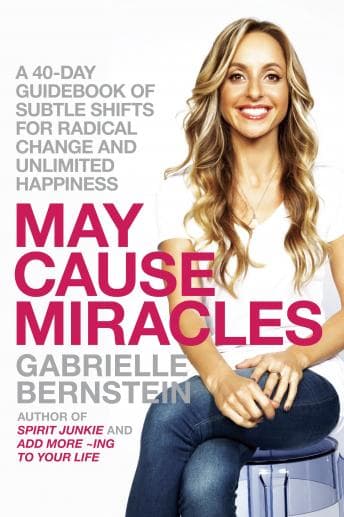

"Witness your fear and choose again."
That line hit me somewhere around day 12, 6:47 AM, crammed between a guy manspreading into my seat and someone's aggressive breakfast burrito. Not exactly a spiritual setting. But here's the thing about Gabrielle Bernstein's 40-day program—it doesn't need incense and yoga pants to work. It just needs you to show up.
Quick Verdict: Worth your commute if you actually do the exercises. Skip if you want passive listening.
A Course in Miracles for People Who Don't Have Three Years
Let me save you some Googling: A Course in Miracles is this dense, 1200-page spiritual text from the 1970s that takes literal years to work through. Bernstein essentially distilled its core concepts—fear vs. love, ego vs. spirit, forgiveness as liberation—into a 40-day sprint. If ACIM is the PhD program, May Cause Miracles is the intensive bootcamp version. Brainstorm takes a similar approach—distilling complex neuroscience into something you can actually use without needing a medical degree.
The structure is dead simple. Each week focuses on a different life area: relationships, self-worth, work, money. Every day gets a morning reflection and an evening exercise. The whole thing runs about 5 hours 40 minutes, which breaks down to roughly 8-9 minutes per day. Perfect for my walk from Caltrain to the office.
Here's where I need to be honest though—this book fights against the audiobook format. The exercises ask you to journal, to sit with questions, to actually pause and reflect. You can't do that while dodging tourists on Market Street. I ended up relistening to each day's segment twice: once during my morning commute for the concept download, then again at night to actually do the work.
Bernstein Narrating Bernstein: The ROI Question
Author-narrated self-help is always a gamble. Sometimes you get someone reading their own book like they're apologizing for it. Bernstein doesn't have that problem. She's a professional speaker, and it shows—clear delivery, natural pacing, occasional wit that lands without trying too hard.
The personal story segments are where the audio format actually adds value. When she talks about her own struggles with fear and ego, there's an emotional texture you wouldn't get from a random narrator. You can hear the difference between "here's the lesson" voice and "here's what I actually lived through" voice.
That said, there's a sameness to the delivery across 40 days that can blur together. By week 3, I was bumping up to 1.5x just to keep my brain engaged. Not because she's slow, but because the repetitive structure (morning reflection, evening exercise, morning reflection, evening exercise) needs some velocity to stay fresh.
The Actual Miracles Part
Look, I'm an engineer. I debug distributed systems. My brain wants proof, metrics, reproducible results. So when a book promises "miracles," my skeptic alarm goes off.
But here's what I noticed: around day 18, I caught myself responding differently to a production incident. Instead of my usual cortisol spike and blame-spiral, I actually paused and asked "what's the loving response here?" (Bernstein's core question.) The incident still sucked. But I didn't carry it home with me for three days.
Is that a miracle? Probably not. But it's a shift. And the book is really about accumulating those tiny shifts until they compound into something bigger. The ROI on this audiobook isn't in the listening—it's in the practicing.
Who Should Queue This Up (And Who Shouldn't)
Perfect for: Anyone who's tried meditation apps and bounced off them, people who respond better to structured programs than open-ended "just be mindful" advice, listeners who can commit to actually pausing and doing the exercises.
Skip if: You want passive listening. This is not a "put it on while you code" book. Also skip if you're allergic to spiritual language—Bernstein uses words like "spirit" and "universe" liberally. If that makes you roll your eyes, the content won't land.
The ideal listening context is dedicated morning time, not background noise. I tried it during a gym session once and retained approximately nothing.
My Debug Report
Three months post-listen, I still use the core framework: notice fear, choose again. It's become a mental subroutine. The 40-day structure gave me enough repetition to actually install the habit, which is more than I can say for most self-help books that could've been blog posts.
Could this have been a blog post? Honestly, no. The daily structure is the product here. The repetition is the feature, not a bug. At 5 hours 40 minutes, it's respectful of your time while still giving you enough runway to actually change something.
Worth a credit if you'll do the work. Worth a library borrow if you just want the concepts. Either way, expect to relisten.