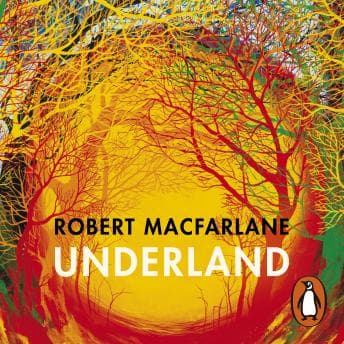

What happens when you realize the ground beneath your feet is basically a distributed system with billions of years of logs you'll never fully debug?
I started this one at 5:47 AM on a particularly packed southbound train, half-asleep, coffee not yet kicked in. By the time we hit Millbrae, I was wide awake and genuinely unsettled—in the best way. Macfarlane describes standing on the Knud Rasmussen glacier in Greenland, watching a massive slab of ice the size of a city block just... collapse. Shear off. Vanish into the meltwater below. And Roy McMillan delivers it with this quiet, measured tone that somehow makes the whole thing more terrifying than if he'd been dramatic about it.
Quick Verdict: Worth your commute, but maybe not your 6 AM zombie commute. This one requires actual neurons.
The Science Actually Holds Up
Here's the thing—I'm skeptical of "nature writing" because half the time it's just vibes dressed up as insight. Macfarlane isn't doing that. When he talks about mycorrhizal networks—the underground fungal systems that let trees communicate and share resources—he's not being metaphorical. He's describing actual biochemistry. It's basically a mesh network, but for forests. The trees are nodes. The fungi are the protocol layer. And they've been running this system for 450 million years without a single production outage.
(I may have texted Kevin at 7 AM: "trees invented kubernetes before we did." He did not respond. Fair.)
The book moves through these underground spaces—Bronze Age burial chambers, Parisian catacombs, cave systems in Slovenia, nuclear waste repositories in Finland—and each one becomes a meditation on what we bury, why we bury it, and what we're leaving for whoever comes after us. The Finland section hit different. They're building a tomb designed to last 100,000 years, to store nuclear waste that will remain lethal for longer than humans have existed as a species. The engineering challenges alone are fascinating, but Macfarlane keeps circling back to the communication problem: how do you warn beings 100,000 years from now not to dig here? How do you write documentation for a species that might not share your language, your symbols, or even your concept of danger?
This is basically "technical debt" but for civilization. Hot Zone wrestled with similar questions about containment and what happens when our systems fail—though Preston's timeline was measured in days, not millennia.
Roy McMillan's Quiet Authority
I don't throw around narrator praise lightly. McMillan doesn't do anything flashy here—no character voices to speak of, no dramatic shifts in register. What he does is maintain this steady, almost hypnotic rhythm that matches Macfarlane's prose perfectly. The book is dense. It's literary. It could easily become soporific in the wrong hands. McMillan keeps it gripping without ever feeling like he's performing.
The emotional moments—especially the concluding sections with Macfarlane's young son—land because McMillan doesn't oversell them. There's a scene where Macfarlane realizes he's trying to teach his child about deep time, about scales of existence that dwarf human life, and you can hear the weight of that in McMillan's delivery without him doing anything obvious. It's just... there.
Perfect For: Long Drives. Skip For: Background Noise
Let me be honest: this is not a 1.5x book. I tried. The prose is too layered, the ideas too interconnected. At 1.25x, it works. At normal speed, it's almost meditative. At 1.5x, you'll miss the connections between the cave art in Norway and the nuclear waste tomb in Finland, and those connections are kind of the whole point.
This is also not a "half-asleep on the train" book. I learned that the hard way. It rewards attention. It punishes distraction. I ended up finishing the last three hours on a Saturday afternoon, sitting in my apartment with headphones on, which is not how I usually consume audiobooks but felt right for this one.
Who Should Queue This (And Who Should git stash)
If you're the kind of person who reads XKCD's "What If" posts and wishes they were longer and more existentially unsettling—this is your book. If you've ever thought about the long-term implications of the systems you build, the data you store, the decisions you make that will outlive you—this is your book. If you want something that makes you feel small but not insignificant, humbled but not hopeless—this is your book.
Skip if you want narrative momentum, clear plot structure, or anything resembling a traditional arc. This is a book about wandering through dark places and thinking about time. The ROI on this audiobook is high, but it's a different kind of return—not entertainment, exactly, but perspective.
I finished this in about 5 commutes plus that Saturday session. And I've been thinking about it for two weeks since. The image of that glacier calving, the silence of those Finnish tunnels, the question of what we're burying for future generations to find—it sticks.
The Commit Message
Macfarlane has written something that functions like the best kind of documentation: it explains the system while making you understand why the system matters. 13 hours is a commitment. It's worth it. Just don't try it at 6 AM.







![Steve Jobs [unabridged audiobook] audiobook cover](/_next/image?url=https%3A%2F%2Fcovers.audiobooks.com%2Fimages%2Fcovers%2Ffull%2F9788499923406.jpg&w=1920&q=75)