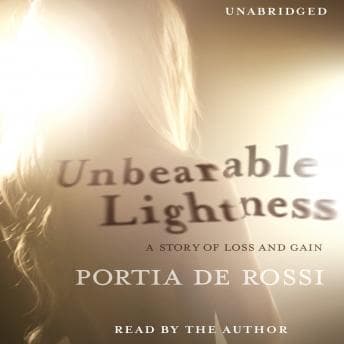

There's a specific kind of silence in the ER when a patient finally tells you the truth. Not the "I fell down the stairs" story, but the real one. The messy, painful one. Listening to Portia de Rossi read Unbearable Lightness felt exactly like that silence.
I started this on my drive home after a particularly rough shift—we had a full board, two traumas, and the coffee machine broke at 2 AM. I thought a celebrity memoir would be easy listening. You know, some Hollywood gossip, maybe some name-dropping about Ally McBeal. (Yes, I watched it back in the day. Don't judge.)
I was wrong. Way wrong.
The Voice in the Confessional
First off, Portia narrates this herself. And thank God she did. If they'd hired some perky voice actor to read about her eating rituals, I would've turned it off at the first stoplight. Instead, her voice is... quiet. Precise. Almost clinical at times.
She talks about starving herself with the same detailed intensity that I use when I'm charting vitals. It's chilling. There were moments on the I-10 where I literally forgot to change lanes because she was describing weighing 82 pounds and collapsing on a set, and my nurse brain was screaming, "Your electrolytes are tanked! Your heart is going to stop!"
She doesn't do the heavy Australian accent here—it's her American acting voice, mostly—but the emotion breaks through. You can hear the exhaustion. It's not a performance; it's a confession. That same unflinching honesty—the kind that makes you uncomfortable because it's so real—is what I loved about When She Woke, though that one trades eating disorders for dystopian punishment.
When the Math Becomes Deadly
What hit me hardest wasn't the Hollywood stuff. It was the math. The obsessive, relentless counting. As a nurse, I deal with numbers all night—blood pressure, O2 sats, drip rates. Portia lived her life by a much darker set of numbers. Calories in, calories out. The scale.
She describes these elaborate rituals around food—how she'd cut things, measure things—and it's terrifying because it makes sense to her in the moment. She puts you right inside the disorder. It's not just "I wanted to be thin." It's about control. It's about fear.
(And honestly, reading about her hiding her sexuality at the same time? It adds this whole other layer of pressure. You just want to reach through the speakers and give her a hug and a sandwich, in that order.)
Not Your Typical Hollywood Fluff
Look, usually when actors write books, there's a ghostwriter polishing the edges. Making it palatable. This feels raw. She talks about the binging, the purging, the physical pain. She doesn't glamorize it.
I've treated patients with severe anorexia. I've seen what it does to the organs. Portia captures the mental state that leads to that physical destruction better than some textbooks I read in nursing school.
But—and here's the warning—it is heavy. This isn't the book to listen to if you're already feeling down or if you have a history with EDs that might be triggered. I found myself sitting in my driveway for ten minutes after I got home, just staring at the garage door, needing to process before I went inside to make pancakes for the kids.
Who This Is (and Isn't) For
Listen if you want an unflinching look at eating disorders from the inside, or if you're a healthcare worker trying to understand what your patients are actually experiencing. Skip it if you're in a fragile headspace or have your own ED history that could be triggered—this one doesn't pull punches.
Charting My Final Notes
It ends with hope—her relationship with Ellen, her recovery—but you have to walk through hell to get there. Brutally honest, and absolutely worth the listen. Just maybe not right before you try to sleep.
My mom always wanted me to be a doctor, but listening to this, I'm glad I'm a nurse. We're the ones who sit there and listen. And Portia? She has a hell of a story to tell.