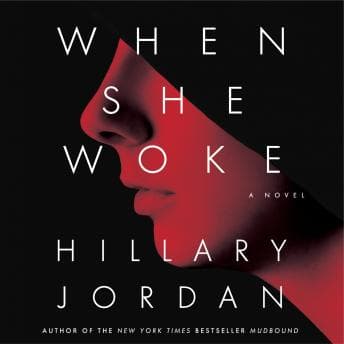

"She is now a convicted criminal, and her skin color has been genetically altered."
That line hit me somewhere around the twenty-minute mark, and I had to pause my walk along the lakefront. Denise asked if I was okay. I wasn't, really. I was already deep in Hillary Jordan's nightmare vision of America, and Heather Corrigan's voice had wormed its way into my brain.
Look, I teach Hawthorne. I've assigned The Scarlet Letter to more teenagers than I can count. That same obsession with guilt and public shame runs through Works of Edgar Allan Poe, Raven Edition, Volume 1, though Poe's characters tend to punish themselves from the inside out. So when I say Jordan is doing something genuinely interesting with that source material - updating Hester Prynne for an age of reality TV and genetic modification - I'm not just being a literature nerd. (Okay, I'm always being a literature nerd.) But this isn't some lazy retelling. It's a provocation.
The Voice That Carried Me Through
Heather Corrigan starts this audiobook doing something smart - she sounds young. Frightened. Almost naive. Hannah Payne isn't a hardened protagonist; she's a woman who devoted her life to church and family, and suddenly she's been "chromed" red for terminating a pregnancy. The vulnerability in Corrigan's early chapters is genuinely uncomfortable. You feel Hannah's shame because Corrigan makes you feel it.
As the story progresses - and Hannah's worldview starts cracking - Corrigan's performance shifts too. It's subtle work. The innocence doesn't disappear; it just gets layered with something harder. Doubt. Anger. She handles the supporting cast well, too. There's a French accent that works, a Bostonian that lands, various Texan drawls that feel lived-in rather than cartoonish. I couldn't find much about Corrigan's background online, but based on this performance? She understands that narration is interpretation, not just reading.
There are a few moments where the pacing feels off - some abrupt shifts that pulled me out of the story. Minor stuff. The kind of thing you notice when you're listening at 1.0x and paying attention to every beat.
Where Jordan Swings Big (And Sometimes Misses)
Here's where I have to be honest with you. Jordan is doing ambitious work here. She's tackling abortion, religious fundamentalism, sexuality, the carceral state - all wrapped in a dystopian package that invites obvious comparisons to Atwood. And yeah, The Handmaid's Tale is the obvious touchpoint. But Jordan's America feels more immediate somehow. More like next Tuesday than some distant future.
The problem? She sometimes lets her politics get ahead of her characters. There are moments - and other listeners have noticed this too - where the supporting cast feels more like archetypes than people. It's the kind of philosophical flattening you get in Beyond Good and Evil, where ideas matter more than the humans carrying them. The narrative wanders in the middle section. I was grading papers during one stretch and realized I'd been half-listening for fifteen minutes without missing much. That's not great.
And the ending. Ugh. I won't spoil it, but it feels rushed. Like Jordan had more story to tell and suddenly ran out of pages. My students complain about this in their own writing - the "I'm tired of this essay" ending. It's frustrating when a professional novelist does it too.
Who Should Listen (And Who Should Skip)
If you loved The Handmaid's Tale or The Testaments, this is worth your time. If you're interested in how contemporary authors engage with classic American literature - the scarlet letter becoming literal, visible, genetic - this is a fascinating case study. I might actually use excerpts in my AP class. (Don't tell Principal Martinez I'm planning curriculum during his budget meetings.)
But if you need tight plotting? If unresolved threads drive you crazy? If you want characters who feel like fully realized humans rather than vehicles for ideas? Skip this one. Or at least go in with adjusted expectations.
Content-wise: there's violence, abortion themes are central to the plot, religious fundamentalism is portrayed critically. Some strong language. Not a bedtime listen unless you want weird dreams.
Would I Listen Again?
Probably not the whole thing. But there are sections - particularly the early chapters where Hannah's world collapses, and a devastating sequence in the middle involving a character named Kayla - that I'd revisit. Corrigan's performance in those moments is genuinely moving.
Jordan's other novel, Mudbound, won the Bellwether Prize. This one made multiple "best of 2011" lists. She's a serious writer doing serious work. The audiobook elevates material that might feel preachy on the page into something more visceral. That's what good narration does.
Is it a great book? No. Is it worth ten hours of your life? If you're the right listener - someone who wants to think, who can tolerate imperfection in service of ambition - yeah. It is.
My mom will probably fall asleep during this review too. That's okay. I wrote it anyway.









