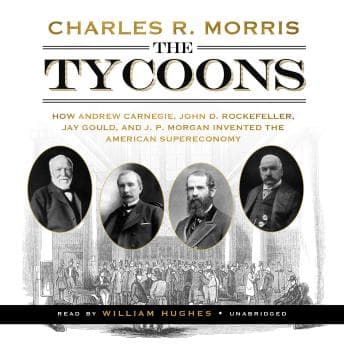

Look, I need to get something off my chest about this book. Charles Morris covers four of the most consequential Americans who ever lived - Carnegie, Rockefeller, Gould, and Morgan - and somehow manages to make railroad rate wars genuinely riveting. That's either a magic trick or good writing. I'm going with good writing.
I picked this one up for a long drive down to a client site in Houston - three hours of I-35 and then I-10, which is about as interesting as watching paint dry in a desert. Ranger was riding shotgun. Perfect conditions for 14-plus hours of Gilded Age economic history.
Four Men Who'd Make Your CEO Look Like a Mall Manager
Here's what Morris does that most business history authors don't: he treats these four tycoons as genuinely different species operating in the same ecosystem. Carnegie is the relentless optimizer - the guy who'd fire his own mother if she couldn't hit production targets, then weep about it while writing a check to build a library. Rockefeller is the cold systematizer, building Standard Oil like someone constructing a machine where every gear has a purpose. Gould - and this surprised me - Morris actually gives Gould a fair shake instead of just painting him as the mustache-twirling villain of Wall Street lore. The man was a provocateur, sure, but Morris makes a solid case that his railroad manipulations, however ugly, forced efficiencies the market wouldn't have found on its own.
And then there's Morgan. The gentleman. The one who believed trust was the actual currency of capitalism. Morris sets up this tension between Morgan's top-down, relationship-based approach and the raw competitive chaos of the other three, and it's a framework that genuinely helps you understand why the American economy developed the way it did instead of following the European model.
What I appreciated most - and I say this as someone who's read maybe a dozen books on this era - is that Morris doesn't just do biography. He embeds these men in the economic mechanics of their time. He walks you through how Bessemer steel production actually worked, why railroad gauge standardization mattered, how Rockefeller's rebate schemes functioned in practice. The author clearly did their homework. Morris was a banker and a lawyer, and it shows in the best way - he understands money flows, not just personalities.
Where the Briefing Gets Dense
This is where it lost me, at least temporarily. Around the middle stretch - the sections dealing with the 1870s-1880s railroad wars - Morris goes deep into rate structures, pooling agreements, and trunk line politics. And I mean deep. I had to rewind a couple of sections because my brain drifted during what felt like the third consecutive explanation of freight rate differentials. At 1.25x, some of those passages blurred together.
It's not bad writing. It's just a lot of economic infrastructure detail packed into a book that's already nearly 15 hours long. If you're genuinely interested in how the American industrial economy was physically built - the rails, the refineries, the steel mills - you'll eat it up. If you're here purely for the personality drama, you'll hit some stretches where you're waiting for the next Carnegie outburst or Morgan power play.
William Hughes narrates with a steady, authoritative tone that suits the material well. He's not flashy - no dramatic voices for Carnegie's Scottish brogue or anything like that - but he reads with clear intelligence and good pacing. For dense nonfiction like this, that's exactly what you want. A narrator who tries to get theatrical with economic history usually just makes it worse. Hughes lets the material breathe. The Earphones Award makes sense here; it's a disciplined, professional performance.
Who Needs This Intel
If you've read Ron Chernow's Titan (Rockefeller) or David Nasaw's Carnegie biography, this is the book that puts them in context together. Morris isn't trying to be definitive on any single tycoon - he's showing you the system they collectively built, often by accident, often by fighting each other. That's a different project, and it works.
Business types will get a lot out of this. History buffs who want to understand why America became an economic superpower between 1865 and 1900 - this is your book. But if you need constant action or narrative momentum, this might test your patience in spots. It's a strategic briefing, not a tactical one.
I will say this: driving through the Texas Hill Country while listening to how these four men essentially invented the modern American middle class hit me in an unexpected way. We take so much of this economic infrastructure for granted. Someone had to build it, and the story of how it happened is wilder and messier than most people realize.
Mission Debrief
Worth your time? Here's the debrief: Morris wrote a smart, ambitious book about the economic engine these four men built, and Hughes delivers it with the right amount of gravity. It's not perfect - the middle drags when the railroad minutiae piles up - but the framework Morris provides for understanding the Gilded Age is genuinely valuable. Got me through the Houston round trip and most of a week of morning runs. Ranger slept through the rate wars but perked up for the Panic of 1893. Smart dog. Though I'll admit, nothing about these audiobook road trips has produced the kind of quiet gut-punch I got from Book of Delights — that one snuck up on me somewhere around Waco and I had to sit with it for a mile before I could figure out why.