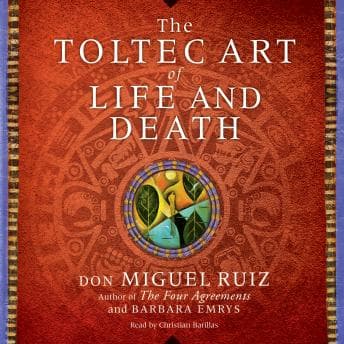

This book is not what you think it is.
I picked up The Toltec Art of Life and Death expecting something like The Four Agreements — clean, structured, quotable wisdom you can stick on a Post-it note above your desk. The closest I've come to that kind of bait-and-switch with a memoir is Home Work: A Memoir of My Hollywood Years, which also arrives wearing one costume and then quietly becomes something else entirely. What I got instead was a fever dream. A beautiful, disorienting, sometimes frustrating fever dream that made me pause my design work and just... sit there. Staring at my screen with a half-finished logo and tears I didn't fully understand.
The Coma Between Worlds
So here's the setup: in 2002, Don Miguel Ruiz had a massive heart attack. Nine-week coma. And this book — written with Barbara Emrys over the course of a decade — is his attempt to capture what happened inside his mind while his body was barely alive. It's not a memoir in any traditional sense. It reads more like a novel, or maybe a lucid dream transcribed. His mother Sarita is trying to pull his spirit back to the living world, traveling through his memories, encountering different versions of Miguel at different ages. Meanwhile, the figures of "Life" and "Death" aren't metaphors — they're characters. They argue. They seduce. They negotiate over his soul.
And honestly? For the first few hours, I was lost. Like genuinely confused about who was speaking, what timeline we were in, whether the woman talking was his mother, his grandmother, or the embodied concept of Life itself. The structure is nonlinear in a way that feels intentional but also... a lot. I was designing packaging labels for a mezcal brand (the irony, I know) and I kept rewinding because I'd zone out during a transition between memory and metaphysical dialogue and suddenly have no idea where we were.
But somewhere around hour five or six, something clicked. I stopped trying to follow it like a plot and started letting it wash over me like — okay this is going to sound pretentious but I mean it — like prayer. Like when my abuela used to pray the rosary and I'd just sit next to her and let the rhythm of it carry me somewhere I couldn't name. That's what this book became for me.
When Ruiz Talks About His Abuela, I Lost It
There are moments in this book where young Miguel is learning from his grandfather, the old nagual, and later from his mother Sarita — who is a curandera, a healer. And the way he describes her hands, her certainty, the way she commands spirits like she's calling children in for dinner... My heart. MY HEART. It hit me in a place I wasn't ready for. Because I grew up watching my abuela do things that weren't exactly curandera-level but lived in that same space — the candles, the prayer, the absolute unshakable conviction that the unseen world was just as real as the kitchen table. And Ruiz writes about that world with such love and zero apology.
I ugly-cried during the sections where Sarita is desperately trying to retrieve her son's spirit. A mother refusing to let death take her child. The ferocity of that love. Frida (my cat, not Kahlo — though also Kahlo, spiritually) climbed into my lap during one of those scenes and I just held her and let it happen.
Christian Barillas Carries a Strange Weight
Here's where I have to be honest: I don't have a ton of reference points for Christian Barillas as a narrator, and the research didn't turn up much either. What I can tell you is that his voice has a calm, steady quality that works for this kind of material — you need someone who can read lines like "You are not what you believe you are" without sounding like a late-night infomercial. He mostly succeeds. There's a warmth there, a groundedness. But — and this is my one real gripe — the book has SO many characters across timelines and planes of existence, and I sometimes couldn't distinguish between them vocally. When Sarita and Lala (Death personified as a red-haired woman) are having a heated exchange, I needed more differentiation. More edge for Lala, more trembling urgency for Sarita. The emotional range felt a bit compressed for a 14-hour listen that asks you to travel between life and death repeatedly.
At 1.0x speed, those 14 hours felt earned but heavy. This is not a background listen. This is a "turn off the design software and close your eyes" book. Or maybe a late-night-in-the-dark book. I listened to the last three hours in bed with the lights off and that was the right call.
Who This Is For (And Who Should Walk Away)
If you loved The Four Agreements and want more of that clean self-help structure — skip this. Seriously. You will be confused and possibly annoyed. But if you're someone who grew up around Mexican or Latin American spiritual traditions, if you understand that sometimes wisdom comes wrapped in story and symbol rather than bullet points, if you're grieving someone and need to sit with the idea that the line between life and death is thinner and more tender than we pretend... then this book will find you right where you need it.
Abuela would have loved this one. She would've said it was too long and also refused to stop listening.
The Candle I'm Still Burning
This book felt like sitting in a dark church after everyone else has gone home. Quiet. A little scary. But the kind of scared that means something real is happening. I'm not sure I understood all of it. I'm not sure I was supposed to. But I felt it in my chest, and two days later, I'm still carrying it around like a stone in my pocket — smooth from being held.