
What if the questions you're avoiding are the exact ones you need to answer?
I started this one skeptical. Look, I've read The Four Agreements like everyone else who's ever been through a quarter-life crisis, but I'm generally wary of sequels in the self-help space. Plant Paradox gave me that same sequel skepticism—promising to upend everything you thought you knew about health. They tend to feel like DLC for a game that was already complete. But I had a 6AM train to catch and my usual sci-fi queue was between series, so here we are.
The Framework That Actually Stuck
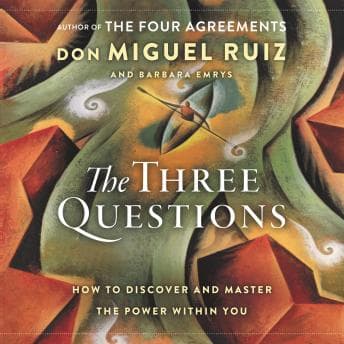
The premise is deceptively simple: Who am I? What is real? How do I express love? Three questions. That's it. And honestly, my first reaction was "this could've been a blog post." But here's the thing—Ruiz and Emrys spend the 3.5 hours unpacking why these questions are so hard to answer honestly, and that's where it gets interesting.
The book argues that we suffer because we either never ask these questions or we lie to ourselves about the answers. And okay, that hit different at 6:47 AM surrounded by other dead-eyed commuters all pretending to be fine. The Toltec wisdom angle might not be everyone's thing, but the practical application is solid. It's basically cognitive behavioral therapy with ancient Mexican spiritual framing.
What I appreciated: the book doesn't promise transformation in 21 days or whatever. It's more like... here's a lens, use it when you're ready. The ROI on this audiobook is slow but compounding.
Christian Barillas Does the Heavy Lifting
Barillas has this warm, clear delivery that works really well for contemplative content. He's got an Earphones Award, which tracks—the guy knows how to pace spiritual material without making it feel like a meditation app you didn't ask for.
But—and this is where I have to be honest—there are stretches where it gets monotone. I zoned out during some of the analogies. There's this whole section using government and politics as metaphors for how the mind works, and I just... couldn't follow it. My brain kept drifting to actual work politics, which was not the vibe.
The pacing is slow by design, I think. This isn't a book you speed through at 1.75x like those startup manifestos. I tried 1.25x and it felt about right—fast enough to stay engaged, slow enough to actually absorb the concepts.
Where It Lost Me (And Where It Found Me Again)
I'll be real: the middle section dragged. Some of the parables felt repetitive, like the same idea dressed in different clothes. If you're someone who needs constant novelty to stay locked in, you might struggle.
But then there'd be these moments—usually right when I was about to give up—where something would land. A question about identity that made me uncomfortable in a useful way. The raw honesty in I'm Glad My Mom Died hit me with that same uncomfortable-but-necessary clarity about identity and family narratives. A reframe on love that wasn't the usual Hallmark stuff. The book is sneaky like that.
The production quality is clean. No weird audio artifacts, no background noise. Just Barillas and the material.
Best For: Train, Not Gym
This is 100% a commute book, specifically for those mornings when you're too tired for plot but want something that makes you feel like you're doing something productive with your brain. It's not gym material—you need too much mental bandwidth. And it's not great for deep work background either.
Queue it if: you're a Four Agreements fan who wants to go deeper, you're in a reflective phase of life, or you've been avoiding big questions about identity and authenticity. Skip if: you need fast pacing or get annoyed by spiritual frameworks.
I finished this in about 4 commutes, and I'm still chewing on some of it. Not every book needs to blow your mind—sometimes it just needs to plant a question that won't leave you alone. This one did that.