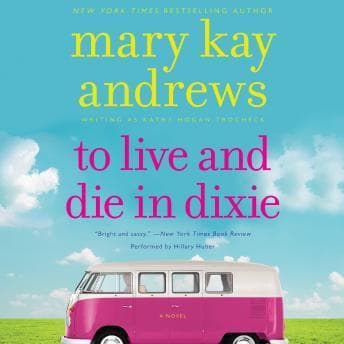

I was supposed to be grading sophomore essays on The Great Gatsby — it was maybe 11:30 on a Tuesday night, the kitchen table covered in papers that all somehow managed to misspell "disillusionment" — when I decided I needed something lighter. Something that wouldn't ask me to think about symbolism or the green light or any of it. So I queued up Mary Kay Andrews' To Live and Die in Dixie, poured myself some bourbon, and let Callahan Garrity take over.
And you know what? For about nine and a half hours, she mostly delivered.
A Cleaning Lady, a Civil War Diary, and Right-Wing Extremists Walk Into Atlanta
Let me set the table here. Mary Kay Andrews was a reporter for the Atlanta Journal-Constitution before she started writing fiction, and you can feel that journalism training in the bones of this book. Callahan Garrity is a former Atlanta cop turned cleaning business owner who moonlights as a PI — which is exactly the kind of premise that sounds absurd until you realize it gives Andrews an excuse to move her protagonist through every stratum of Atlanta society. Rich antiques dealers. Sketchy neo-Confederate collectors. Teenagers who are way too nosy for their own good. The setup — finding a priceless Civil War diary written by a madam — is deliciously pulpy, the kind of thing that makes you think Andrews was having a fantastic time writing it.
The book is the second in the Callahan Garrity series, and it has that second-book confidence. Andrews isn't explaining who everyone is with heavy-handed backstory dumps. She trusts you to keep up. The mystery itself is solid if not spectacular — you're not going to be floored by the reveal — but that's not really the point. The point is Callahan's voice: sharp, funny, exasperated in a way that feels earned. She reminded me of the best students I've had over twenty years — the ones who are smarter than the room but too polite to say so.
This reminds me of what Hemingway said about writing — that the dignity of movement of an iceberg is due to only one-eighth of it being above water. Andrews keeps things breezy on the surface, but there's real Atlanta geography and Civil War history underneath. She did her homework. (Something I cannot say about most of my sophomores.)
Hillary Huber and the Pronunciation Problem
Here's where things get complicated. Hillary Huber narrates with energy and wit. She captures Callahan's sass — that slightly world-weary amusement that carries the whole series. When the dialogue is flowing and Callahan is trading barbs with someone, Huber is right there with it. Her pacing is good. Her timing on the comedic beats is good.
But.
If you're going to narrate a book set deeply in Atlanta, in a story that trades on Southern culture and Civil War history and the specific geography of a real city — you need to get the names right. Huber pronounces "Chamblee" as "Shamblee," which is the kind of thing that might slide past a listener in Chicago (guilty) but would make anyone from metro Atlanta wince. And it's not an isolated incident. There are other Southern terms and place names that hit wrong, and once you notice the pattern, it's hard to un-notice.
The narrator understands that pause is punctuation — Huber gets that right, gives the humor room to breathe. But a mispronounced place name is like a wrong note in a jazz solo. One, you can forgive. A pattern of them starts pulling you out of the world Andrews built. It's frustrating because the performance is otherwise sharp. I kept thinking: someone should have had a dialect coach sit with her for an afternoon. That's all it would've taken.
Who Gets the Assignment (and Who Gets a Pass)
If you loved Sara Paretsky's V.I. Warshawski books, this is their spiritual successor — transplanted south, with more humor and less noir. Cozy mystery fans who want a protagonist with actual teeth will find a lot to like here. It's perfect listening for housework or a long walk — engrossing enough to keep you company but not so demanding that you'll miss a plot point if the wind off Lake Michigan steals your attention for a minute.
My students would hate this. I love it. Not because it's literature with a capital L — it isn't trying to be — but because Andrews writes with the confidence of someone who knows exactly what kind of book she's making. There's craft in that. Real craft. That same confidence in knowing exactly what story you're telling — no apologies, no pretension — is something I noticed in Alchemist, which operates in a completely different register but shares that quality of a writer who trusts the reader to meet them where they are.
But if you're a stickler for narration accuracy, or if you know Atlanta well enough that "Shamblee" would ruin your afternoon — maybe grab the print edition instead. The writing deserves better than to be undercut by avoidable mistakes.
Worth Pausing the Grading For?
Almost. It's a fun listen, a smart mystery, and a narrator who's about 80% of the way to great. That missing 20% keeps it from being a full recommendation at credit price. Wait for a sale, or catch it on your library app. Then put on your walking shoes and let Callahan do her thing. She's good company — even if her narrator occasionally needs a map of Georgia.