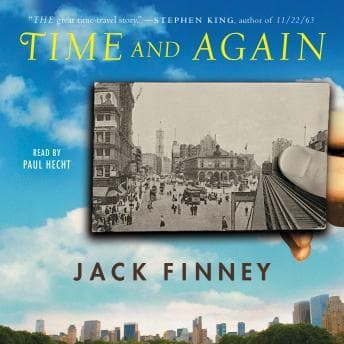

What would you actually do if someone handed you the keys to 1882?
I don't mean the sanitized, sepia-toned version of the past we get in period dramas. I mean the real thing — the smell of horse manure on cobblestones, the gas lamps flickering on streets that would later sprout skyscrapers, the particular loneliness of knowing things about the future that no one around you could possibly understand. That's the question Jack Finney's Time and Again poses, and after seventeen hours with Paul Hecht in my ears, I'm still turning it over.
I started this one on a Saturday morning walk along the lakefront with Denise. By hour three, she'd peeled off to meet her sister for brunch and I just... kept walking. Past our usual turnaround point, past the dog beach, past the point where the path gets a little sketchy near Rogers Park. That's the kind of book this is. You forget where you are because Finney has made you believe — genuinely believe — that you're standing on Broadway in 1882, watching the Dakota apartment building rise against a skyline that hasn't yet learned to reach.
Finney Builds Old New York Like a Man Who Refuses to Let It Die
Let me be clear about what this novel is and isn't. It is not a sci-fi thriller. If you're expecting frantic time-paradox tension or chase sequences through wormholes, you will be disappointed and probably a little annoyed. What Finney does instead is something I find far more ambitious and far harder to pull off: he reconstructs 1882 Manhattan with the obsessive care of a historian who also happens to be a romantic. The original book even included period photographs and sketches — and while you obviously lose those in audio, Hecht's narration compensates by letting Finney's descriptive passages breathe.
And those passages are long. Si Morley will spend paragraphs describing the way gaslight falls on snow in Central Park, or the texture of a newspaper advertisement, or the specific chaos of an open-air market near the waterfront. This is where I imagine some listeners bail. The pacing is deliberate — leisurely, even. My students would hate this. I love it. The prose deserves to be savored, and Finney chose those words with the precision of someone who understood that world-building isn't just about plot mechanics. It's about convincing you that a place existed.
This reminds me of what Hemingway said about prose architecture — the dignity of an iceberg comes from what's below the surface. Finney's iceberg is all research and love for a vanished city, and Si Morley is just the vessel floating on top of it.
Paul Hecht Knows That Pause Is Punctuation
Hecht's voice is the right voice for this material. He's got this steady, masculine warmth — think of that uncle who could hold a room at Thanksgiving just by telling a story about something mundane. His Si Morley sounds like a man who's genuinely astonished by what he's seeing, not an actor performing astonishment. There's a difference, and Hecht lands on the right side of it.
Where he really earns his keep is in the emotional pivot points — particularly when Si starts falling for Julia, the woman from 1882 who represents everything his modern life lacks. Hecht shifts into something quieter in those scenes, almost intimate, like he's letting you overhear a private thought rather than narrating it. The narrator understands that pause is punctuation. He never rushes the romantic tension, and he never oversells it either. (Nine AudioFile Earphones Awards. I get it now.)
The one caveat: if you're someone who listens at 1.5x or higher, this performance will lose its shape. Hecht is pacing himself like a long-distance runner, and speeding him up would flatten the very thing that makes his reading work. I listened at 1.0x — obviously — and I'd recommend you do the same.
The Love Story That Sneaks Up on You While You're Admiring the Architecture
Here's what the author is really saying, underneath all the gorgeous period detail: modern life is a kind of exile. Si Morley doesn't just prefer 1882 because it's picturesque. He prefers it because it feels real to him in a way that his advertising job and his 20th-century apartment never did. The mystery of the half-burned letter and the ominous references to world-destroying fire — those are plot engines, sure. But the heart of the book is Si standing in a vanished Manhattan and realizing he doesn't want to leave.
And the choice he faces — stay in the past with the woman he loves or return to his own time — isn't played for melodrama. Finney treats it with the quiet weight it deserves. By the time I reached the final chapters (grading papers at 11 PM, red pen abandoned on a stack of sophomore essays about The Great Gatsby), I wasn't thinking about time-travel mechanics. I was thinking about what it means to choose a life.
If you loved The Age of Innocence, this is its spiritual successor — wrapped in a science fiction premise that Finney wears as lightly as a period overcoat.
Who Gets an A, Who Gets Excused
This is for readers who want atmosphere over action. For people who find old maps beautiful. Rebecca of Sunnybrook Farm scratches a similar itch — it's not about a vanished city, but Wiggin conjures a vanished rural world with that same unhurried devotion to place that Finney has here. For anyone who's ever stood on a city street and tried to imagine what it looked like a hundred years ago. It's also — and I say this as someone who was a snob about audiobooks for years — a perfect argument for the format. Hecht's narration turns Finney's descriptive passages into something almost meditative.
Skip it if you need fast plotting, if long descriptive stretches make you reach for the fast-forward button, or if you want your time-travel hard and paradox-heavy. This is a slow dance, not a sprint.
Stephen King called it "THE great time-travel story." I wouldn't fight him on it. Worth pausing the faculty meeting for — and I did, twice.