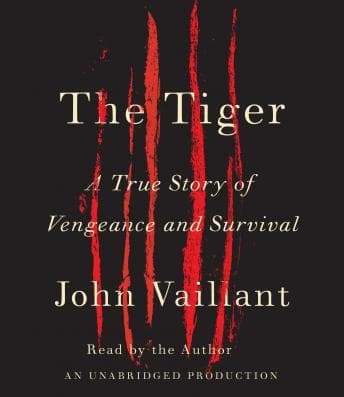

So there I was, 2AM, post-incident review finally done, too wired to sleep but too fried to look at another terminal. Kevin was passed out, the apartment was dead quiet, and I had twelve hours of a book about a vendetta-driven Siberian tiger waiting on my phone. I figured I'd listen for twenty minutes and drift off. I finished six hours before my alarm went off.
That should tell you something.
A Tiger With a Grudge and a 400-Square-Mile Kill Zone
TL;DR: Worth your commute — but barely. This is basically a true crime podcast but the serial killer is a 600-pound Amur tiger systematically hunting down one specific poacher in the Russian Far East. And the science actually holds up.
Here's what hooked me: this tiger isn't randomly attacking humans. It tracked down Vladimir Markov — a down-on-his-luck poacher who'd injured it — went to his cabin, destroyed everything that smelled like him, and waited. The tiger essentially staked out this man's home. When Markov returned, the tiger didn't just kill him. The trackers found... pieces. Boots with feet still in them. Vaillant doesn't sensationalize this (okay, maybe a little), but the forensic detail of Yuri Trush's team reconstructing what happened from tracks and remains reads like a distributed systems postmortem. Except instead of tracing RPC failures across microservices, you're tracing a 10-foot predator's logic across frozen taiga.
And that's the thing — the tiger has logic. Vaillant spends serious time on the neuroscience and behavioral ecology of Amur tigers, and the argument that this animal was engaged in premeditated, targeted revenge is disturbingly convincing. There's a section where he explains how tigers create mental maps of their territories that rival GPS precision, remembering individual encounters with specific humans for months. My brain kept mapping this to caching and state management. This tiger had persistent memory and a grudge queue that did not flush.
The Detours That Test Your Patience (But Earn Their Place)
Okay, here's where I have to be honest. There are long stretches — and I mean long — of historical context about Russian colonization of the Primorye region, the collapse of the Soviet economy, indigenous Udege tribes, and the geopolitics of tiger conservation. Around hour 5, I was on the Caltrain at 6:47AM and I fully zoned out during a section about 19th-century Russian settler economics. Lost maybe fifteen minutes.
But here's the debug on that: those sections aren't filler. They're building the dependency graph. You can't understand why Markov was poaching — or why the entire ecosystem was destabilized enough for a tiger to start targeting humans — without understanding the cascading failures. Post-Soviet poverty pushed people into the forest. Poaching destabilized prey populations. Starving tigers started encountering starving humans. It's a systems failure story dressed as a nature book. Once I reframed it that way, the pacing clicked.
Still. Could've been tighter by maybe 90 minutes. Some of the historical tangents repeat their own conclusions.
Vaillant Reading Vaillant — A Mixed Commit
The author narrates his own book, and this is where opinions diverge hard. His voice is measured, almost professorial, with these deliberate dramatic pauses that work beautifully during the quiet tension of the tracking sequences. When he describes the team approaching a kill site in -30°F silence, his pacing makes you feel the cold — I literally pulled my hoodie tighter on a 68-degree train car.
But during the actual confrontation scenes? He stays in that same register. The final showdown in the taiga clearing — which should be absolutely electric — lands at maybe 70% of its potential because his delivery doesn't shift gears. I kept thinking a narrator like Ray Porter would've destroyed this material. Porter's ability to shift from analytical calm to visceral intensity is exactly what this book needs. Vaillant gives you the calm. The intensity stays frustratingly level.
That said, I've heard worse author-narrations. Way worse. He clearly understands his own rhythms, and for the 80% of the book that's investigative journalism and natural history, his voice fits perfectly.
Speed and Context Calibration
Perfect for: long commutes, road trips, insomnia. Skip for: background listening, gym. This book requires actual attention — the narrative jumps between timelines (the hunt, the history, the ecology) without always signposting clearly, and at 1.5x I occasionally had to rewind when a new chapter shifted context.
I'd actually recommend 1.25x for this one, which I almost never say. The pauses are intentional and the density of information is high enough that speeding through loses you details that matter later.
The ROI Calculation
The ROI on this audiobook is strong but front-loaded — you'll think about apex predator cognition, post-Soviet collapse, and human-wildlife coexistence for weeks. I've since fallen into a Wikipedia hole about Amur tiger conservation that Kevin finds "concerning." The pacing and narration knock it down from must-listen territory, but the story itself is genuinely one of the most extraordinary pieces of narrative nonfiction I've encountered. A tiger. With a vendetta. That's not a metaphor. That actually happened.
Who should grab this: anyone who loves narrative nonfiction in the vein of Jon Krakauer or Erik Larson, anyone interested in animal cognition, anyone who wants to understand what happens when complex systems (ecological, economic, political) fail simultaneously. River of Doubt scratches a very similar itch — brutal environment, cascading human failure, and a pacing that earns its slow stretches. Skip if you need constant action or can't tolerate extended historical context between set pieces.









![Steve Jobs [unabridged audiobook] audiobook cover](/_next/image?url=https%3A%2F%2Fcovers.audiobooks.com%2Fimages%2Fcovers%2Ffull%2F9788499923406.jpg&w=1920&q=75)